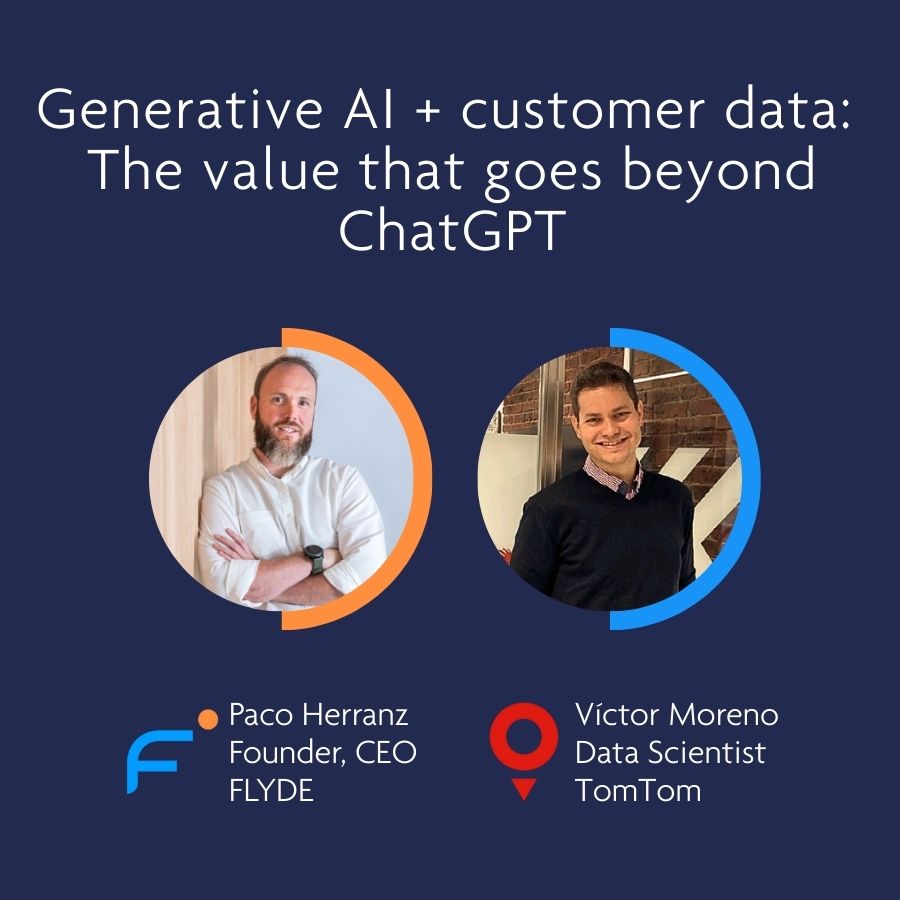

At the third FLYDE Talks event, FLYDE Founder and CEO, Paco Herranz, was joined by Víctor Moreno, Staff Data Scientist at TomTom, to explore the current state of generative artificial intelligence and its technological, professional and social implications. The discussion covered how we got to this point, what is truly changing, and the challenges companies must face in this new phase. A full recording of the event (in Spanish) is available.
A TECHNOLOGY THAT WASN’T BORN YESTERDAY
The conversation highlighted that while generative AI is currently trendy, AI itself is not a new concept. Its roots go back to early examples such as data analysis during World War II or the rule-based systems of the 1970s and 1980s.
The recent leap forward is not due to a new idea, but to technological advances that finally made long-standing concepts viable. GPUs enabled massive and efficient parallel computation. Natural Language Processing (NLP) allowed text to be converted into numbers more accurately. And the availability of large volumes of data made it possible to train much more powerful models.
THE DEMOCRATIZATION OF AI
The most recent change has been the democratization of access. Previously, working with AI required specific technical knowledge. Today, anyone can use it through simple interfaces like ChatGPT. This shift goes beyond workplace implications and into the social realm, changing how we perform personal tasks, such as asking an assistant for trivial data.
Víctor highlighted how this change is transforming even the way we ask questions. We rely on assistants to solve doubts, summarize information, or make initial decisions. This change is profound: it effects how we think, evaluate and structure our work.
By lowering the barrier to entry, adoption accelerates. Companies that do not adapt risk falling behind—not due to a lack of technology, but due to a lack of understanding of how to incorporate it effectively.
THE VALUE OF AI IN PRODUCTIVITY AND CREATIVITY
Víctor highlighted two key areas of value:
- Productivity: AI allows large amounts of information to be processed, content to be summarized, alternatives to be proposed, and tasks that previously took hours to be automated. For example, in programming, AI is improving productivity by an estimated 10–15%.
- Creativity: AI enhances creativity by removing the “fear of the blank page” and offering new ways to solve problems or start projects.
SPECIFIC APPLICATIONS IN MARKETING
Marketing is among the areas in which generative AI is growing exponentially. Personalization has been taken to a new level, handling thousands of micro-segments. Content can adapt dynamically. Campaigns can be optimized in real time. The list goes on.
At FLYDE, we’ve developed tools like FLYDE Brain, which proposes audiences from simple descriptions, analyzes behaviors, and suggests campaign optimizations, empowering teams to unlock more of AI’s potential for data-driven marketing.
Other AI applications in marketing include:
- Virtual replicas, which simulate how a customer might react to a message.
- Virtual replica farms, to conduct quick, low-cost surveys and market studies.
KEY RISKS AND CHALLENGES
Despite the progress, generative AI has significant limitations that must be carefully managed.
- Work slop: Poorly generated content can reduce productivity and damage credibility.
- User responsibility: Models are designed to respond, not to question. As Víctor explained, they can “lie” if the prompt pushes them in that direction. Ultimately, the user is responsible for what is generated. If “the car crashes,” the driver is responsible.
- Security risks: There is a risk of prompt injection, where the text consumed by the agent can be modified to influence its actions, potentially leading to unwanted access to databases if proper protection is not in place.
- Legality and data: In Europe, regulations such as GDPR require responsible and secure use. Platforms like FLYDE allow AI to work with real customer data in a controlled environment, avoiding unnecessary risks.
- Rising costs: Token prices will increase, so responsible and efficient use of AI is necessary.
FINAL ADVICE ON THE IMPORTANCE OF ADAPTING
Víctor emphasized the importance of adapting to the new paradigm, comparing it to the shift from the steam engine to the electric engine: industries took decades to realize they not only had to replace the engine, but completely change their work structures to leverage the new technology.
Looking forward, the challenge for companies will be learning to integrate this technology in a safe, responsible, and strategic way. At FLYDE, we will continue driving conversations that help understand this new scenario and leverage AI within a safe, results-oriented framework.
Contact us to learn more about how FLYDE can help your business leverage AI’s capabilities.