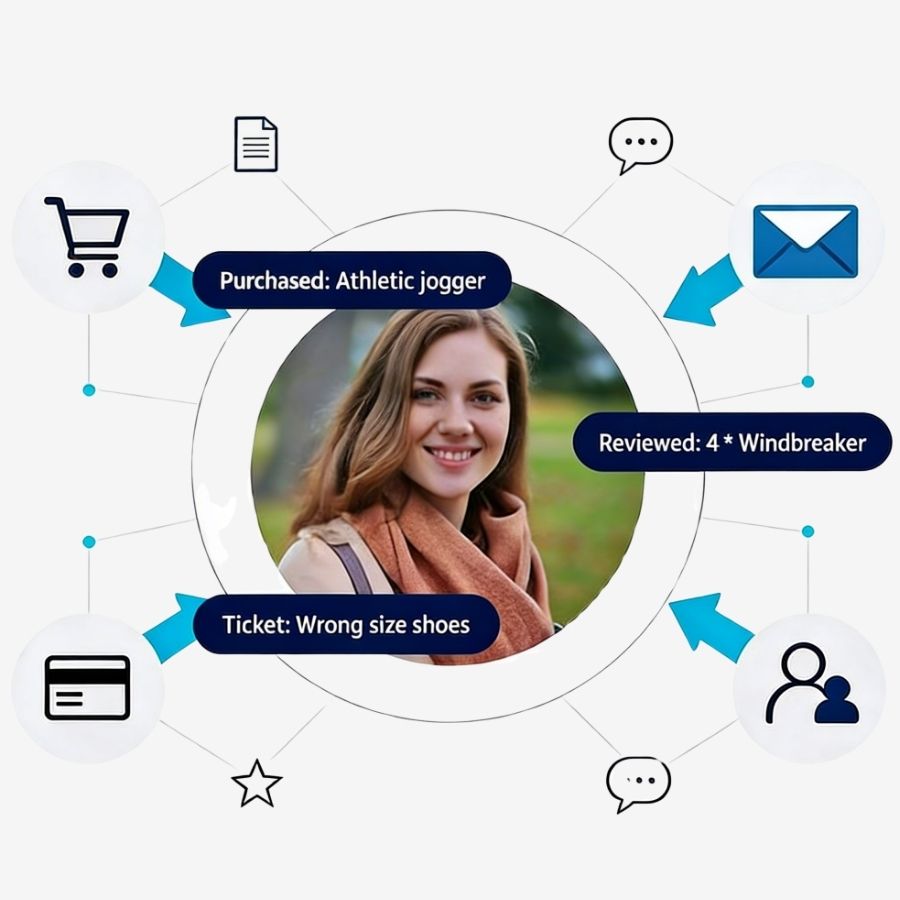

Most companies store customer data across multiple tools. The CRM records sales interactions. The email platform stores campaign history. The ecommerce system tracks orders. The customer support tool logs tickets. Each system has its own version of the customer. And none of them talk to each other.
The result is predictable: decisions based on partial information, marketing campaigns that ignore what customer support already knows, and customers receiving irrelevant messages because no one has a complete picture of who they are. The CDP exists to solve exactly that problem.
Understanding what a CDP is is only the first step. The real challenge is not just unifying data, but using it consistently to improve marketing decisions, retention, and campaign efficiency. In this series, we explore how to do that in practice.
WHAT IS A CUSTOMER DATA PLATFORM (CDP)?
A CDP, or Customer Data Platform, is software that collects customer data from multiple sources and unifies it into a single profile for each customer, primarily based on first-party data.
Unlike other data tools, a CDP is designed specifically to manage first-party data, meaning the data generated through your direct relationship with the customer. In simple terms, a CDP unifies data from all of your sources in order to reveal who each customer is, what value they represent for your business, and how likely they are to buy or churn.
The value doesn’t come from having this data, but from being able to use it operationally in marketing and business decisions.
HOW A CDP IS USED IN MARKETING?
Advanced segmentation
Rather than segmenting by basic demographic variables such as age, location or gender, a CDP lets you build audiences based on real behaviour: customers who have purchased more than twice in the last 60 days, customers showing high churn propensity based on usage patterns, high-value customers who haven’t engaged in weeks. These segments update dynamically, without manual exports.
Personalization at scale
With a unified profile per customer, messages can be adapted to each person’s real context: their history, their preferred channel, their stage in the customer lifecycle. Personalization stops being a one-off project and becomes part of standard operations.
Data activation in campaigns
The value of unified data comes from being able to use it where decisions actually happen. A bottleneck often forms between data and action: the marketing team identifies a segment they want to activate, requests it from IT, IT prepares it, and by the time the audience is ready, the context has changed. For companies with high customer turnover or short purchase cycles, this delay is especially costly.
A CDP removes that intermediary. Segments are built directly on unified data and sync automatically with execution channels. The email platform launches the campaign with the right audience, the paid media manager excludes customers who already purchased, the customer service system shows the customer’s full context before the agent picks up the phone. Everything runs on the same profile and updates every time the customer does something new.
Precise attribution
By unifying customer behavior across all touchpoints, a CDP helps you understand which channels and campaigns actually contribute to conversion—and which ones simply appear along the journey without influencing the decision.
HOW DOES A CDP WORK?
A CDP operates across three layers that work continuously.
Data ingestion
The CDP ingests data from all relevant sources: website, app, ecommerce platform, CRM, email tools, customer service system, point of sale where applicable. This ingestion can happen in real time or in batches depending on the need, and the CDP can process both structured data and behavioural events.
Profile unification
Once data is received, the CDP consolidates it into a single profile per person. This means resolving the customer’s identity across different identifiers such as email, phone number, user ID and navigation fingerprint, to ensure that interactions from the same person across different channels are attributed correctly and don’t create duplicate or contradictory profiles.
Data activation
The unified profile is made available to other systems. The marketing team can build segments and push them to their paid media platform. The email tool can personalise content based on the customer’s history. The customer service agent can see full context before responding.
CDP vs. CRM vs. DMP: WHAT’S THE DIFFERENCE?
It’s common to confuse these three technologies because they all work with customer data, but they serve different purposes, have different scopes, and are used by different teams.
What is a CRM?
A CRM (Customer Relationship Management) is a platform designed to manage relationships with customers and prospects. It centralizes key information such as contacts, sales interactions, and deal stages, and helps sales teams organize and track their pipeline.
What is a DMP?
A DMP (Data Management Platform) is a tool focused on audience management for advertising. It collects and combines data, primarily from third-party sources, to create highly specific segments that can be activated in marketing and digital media campaigns.
Summary of the three tools:
.flyde-compare{ font-family:-apple-system,BlinkMacSystemFont,"Segoe UI",Roboto,Arial,sans-serif; margin:40px 0; } .flyde-compare table{ width:100%; border-collapse:separate; border-spacing:0; border:1px solid #e6e8ec; border-radius:14px; overflow:hidden; box-shadow:0 6px 18px rgba(0,0,0,0.05); } .flyde-compare th{ background:#ff8e3e; color:#fff; padding:18px; font-size:13px; text-transform:uppercase; letter-spacing:.05em; text-align:center; } .flyde-compare th:first-child{ text-align:left; } .flyde-compare td{ padding:18px; border-top:1px solid #eef0f3; font-size:15px; color:#334155; text-align:center; } .flyde-compare td:first-child{ text-align:left; font-weight:600; background:#f8fafc; color:#0f172a; } .check{ color:#16a34a; font-weight:700; font-size:18px; } .cross{ color:#ef4444; font-weight:700; font-size:18px; } .partial{ color:#f59e0b; font-weight:700; } @media(max-width:768px){ .flyde-compare table{ display:block; overflow-x:auto; } }
| Feature | CDP | CRM | DMP |
|---|---|---|---|
| Unified customer profile | ✓ | Partial | ✕ |
| Behavioral data | ✓ | Limited | ✓ |
| Transactional data | ✓ | ✓ | ✕ |
| Anonymous data | ✓ | ✕ | ✓ |
| Audience activation | ✓ | Limited | ✓ |
| Main use case | Marketing and personalization | Sales and customer management | Programmatic advertising |
| Data updates | Real-time | Manual / partial | Campaign-based |
The relationship between CDP and CRM is particularly worth understanding: they are not competitors. The CRM manages the commercial process and the relationship with known customers. The CDP provides the layer of behaviour and value that makes that process more intelligent. In many companies, the CDP feeds the CRM with context it couldn't build on its own.
CDP USE CASES
Personalizing retention campaigns
A fashion retailer with both ecommerce and physical stores uses its CDP to identify customers who are starting to disengage: fewer purchases over the past 90 days, lower interaction with campaigns, and no recent visits to the website or stores.
Before losing them, the retailer activates a targeted campaign for this segment. The message, channel, and incentive are tailored to each customer’s value, with product recommendations based on past purchases, early access to new collections, or a personalized offer to drive the next purchase.
Optimization of paid media campaigns: audience exclusion
An office supply retailer with physical stores and an ecommerce channel runs paid media acquisition campaigns. The problem: their advertising platforms only see what happens in the digital channel. A customer who bought in-store last week still appears as a prospect in the ads system and keeps receiving acquisition messages. Not only do the messages annoy the customer, but they also represent wasted spend for the company.
With a CDP that unifies data from physical stores and digital channels into a single profile, that customer is removed from acquisition audiences as soon as their purchase completes, regardless of where it happened. The exclusion is automatic and updates in real time. The budget that was being spent trying to convert someone who already converted gets redirected towards real prospects or towards loyalty campaigns for that same customer.
Customer behavior analysis: understand what makes a client stay
A gym chain notices that churn is concentrated in the first 60 days. The problem is that all new members look identical at sign-up, with the same membership fee and the same contract, but some disappear within weeks while others stay for years.
Using the CDP, the chain crosses first-30-day behaviour with long-term retention and finds the pattern: members who attend at least three times in their first week and take part in at least one group class before day 15 have a significantly higher 12-month retention rate than the rest. The pattern in the data is clear.
Armed with that insight, they redesign onboarding: new members receive specific communications pushing them towards those two behaviours in their first week. Not discounts or generic welcome messages, but actions designed to guide them towards the behavior that predicts long-term retention.
WHY CDPS MATTER FOR MODERN BUSINESSES
Omnichannel marketing
Customers interact with brands across multiple touchpoints, such as web, app, physical store, social media and customer service, and expect a consistent experience across all of them. Without a layer that unifies those interactions, consistency is impossible: each channel operates on its own incomplete version of the customer, unaware of what happened elsewhere.
Data-driven decisions
As marketing teams take on greater accountability for business outcomes such as retention, margin, and cost to serve, they need data that goes beyond campaign metrics. A CDP provides the foundation to measure real impact, not just activity.
A CDP helps teams move from fragmented data to more consistent and informed decisions.
Campaign efficiency
The ability to segment precisely, exclude people who shouldn't receive a message, and personalize based on real context reduces advertising waste and improves conversion without necessarily increasing budget.
ACTIVATE YOUR DATA WITH FLYDE
Having a CDP is the first step. Real value appears when data becomes concrete actions with measurable business impact.
FLYDE combines CDP technology with strategic and operational support to help companies see results in weeks, not months. The focus is on identifying the highest-return use cases from the start, executing them with rigor, and measuring impact incrementally, so that every investment decision is backed by real data, not assumptions.
If you want to explore how a CDP can apply to your specific context, Enrique Miralda's ebook, CDP: How to Turn Data into Business, on customer data platforms is a good starting point: it covers everything from the fundamentals to a 90-day roadmap with real results.