
Category: CDP
Think about how your customers actually make purchasing decisions. It rarely happens in a single visit. They research, compare, leave and come back. The process can span days, cross multiple devices and channels, and in most cases ends with a conversion that the marketing team attributes to the last touchpoint, inadvertently ignoring everything that came before.
For most brands, everything that happened before a user registers is invisible. No name, no email, no known identifier. Each anonymous session exists in isolation, disconnected from every other. The customer appears in the CRM as if out of nowhere, when in reality they’ve spent days signaling exactly what they want.
This is the blind spot in modern digital marketing: the gap between the first touchpoint and the moment of identification. In sectors like retail, travel, financial services, and automotive, this gap accounts for between 60% and 90% of unique visitors to a website. And it’s where purchase intent is formed.
THE OLD TRACKING MODEL
For years, the industry’s answer was third-party cookies: identifiers managed by ad networks and analytics platforms that allowed brands to follow users across sites and reconstruct parts of their digital journey.
But those identifiers have been in retreat for years. Safari blocked them by default in 2017 with Intelligent Tracking Prevention. Firefox followed with Enhanced Tracking Protection in 2019. GDPR in Europe and equivalent privacy legislation in other markets placed them under explicit consent requirements that dramatically reduced their real-world coverage. And while Google ultimately decided to keep them in Chrome, it did so with added user controls that make any strategy built on third-party cookies structurally unstable.
The result is a structural shift that forces every brand to answer a question it could previously ignore: what first-party identifiers are we going to build our customer data model on?
WHAT SOLUTIONS ARE AVAILABLE TODAY?
Today’s technology covers technical approaches for recovering visibility into that anonymous gap without relying on third parties. On the browser side, the two main options are first-party cookies, identifiers that the brand’s own domain sets and controls, and browser fingerprinting, which recognizes a returning device based on the combination of technical signals the browser naturally exposes: operating system, screen configuration, rendering engine, and others. On mobile, where between 40% and 70% of sessions occur in native apps across most B2C sectors, the solution involves native SDKs that manage platform identifiers such as IDFV on iOS or App Set ID on Android.
When these techniques are integrated into a Customer Data Platform (CDP), anonymous behavioral data and known profile data can coexist in a single record from the moment a user first identifies themselves. The CDP acts as the identity resolution layer: it doesn’t just store the data, it executes the unification process and maintains the full journey trace, including all pre-registration history.
One critical point that often gets overlooked: doing this correctly does not require compromising user privacy. First-party fingerprinting does not track users across domains, operates on consent, and can be implemented within a robust legal framework under GDPR and equivalent regulations. Privacy and journey visibility are not competing objectives. They are design constraints that a well-built architecture can satisfy simultaneously.
Each approach carries a different profile of technical robustness, stability window, and regulatory fit. The choice between them depends on the sector, the typical journey length, and the data architecture of each organization. Our whitepaper, Identificación online de usuarios anónimos: métodos y alternativas. details the criteria for making that decision.
WHAT CHANGES WHEN THE FULL JOURNEY IS AVAILABLE
Recovering the anonymous segment of the customer journey is not an analytics project. When anonymous behavioral data and the known profile are merged into a single record, with pre-registration history intact and original timestamps preserved, the quality of questions the business can ask changes entirely: when to activate a campaign, who not to retarget, which segments have genuine purchase intent versus which ones simply browsed. Reconstructing the full customer journey enables a clear competitive advantage.
Brands that close the blind spot are operating with the right data, at the right moment, on their customers’ real journey. First-party identity is not a borrowed identifier from the adtech stack. It’s a capability each brand must build on its own infrastructure, its own consent, and its own domain.
The complete technical architecture, its legal implications, and its application in production are covered in our free whitepaper, Identificación online de usuarios anónimos: métodos y alternativas.
The Customer Data Platform (CDP) use cases with the highest return in ecommerce are not necessarily the most sophisticated ones but rather the ones that act on the variables that most affect the bottom line: customer acquisition cost, margin per sale, customer retention, and long-term customer value.
The return on investment (ROI) of a CDP depends on which use cases are activated and with what precision. Unified data only generates return when it translates into more precise decisions about who to target, when, with what message, and also who not to target.
For more use cases with full activation detail and ROI calculation, we recommend the ebook CDP: How to Turn Data into Business by Enrique Miralda, available in Spanish as a free download.
1. AUDIENCE SUPPRESSION: HOW TO USE A CDP TO STOP WASTING AD SPEND
A significant portion of advertising spend in ecommerce is wasted on impacting users who should not see the particular ad. For example, customers who bought in the last 48 hours should not still see ads for the same product. Users with an open complaint should not be targeted in an upselling campaign. Repeat buyers with a high probability of returning organically should not consume our acquisition budget. Without unified data across channels, these overlaps are unavoidable.
A CDP makes it possible to build and update in real time the segments that should be excluded from each campaign and sync them automatically with paid media platforms. The team no longer needs to manage lists manually or depend on periodic exports. Exclusion happens continuously and automatically.
To illustrate: an electronics retailer with both an online channel and physical stores found that 19% of its active Meta campaign audience had made a purchase in-store within the last 30 days. That segment was being excluded manually every two weeks, leaving an unnecessary window of exposure. By automating the exclusion with the CDP, that overlap disappears continuously. The budget stops being spent on reaching customers who have already converted, without any intervention needed from the team.
2.CHURN REDUCTION: HOW TO USE A CDP TO ACT ON AT-RISK CUSTOMERS BEFORE IT’S TOO LATE
Most companies detect churn after it has already happened: the customer cancelled their subscription, didn’t renew, or simply stopped buying. By that point, intervention is more expensive and less effective.
A CDP makes it possible to identify risk signals before the customer makes that decision: declining visit frequency, a drop in average order value, email opens without conversion, customer service tickets left unresolved. With those signals consolidated in a single profile, it becomes possible to trigger early interventions, segmented by risk level, with the right channel and message for each customer.
A cosmetics brand defined a risk segment based on three combined signals: more than 60 days without account access, a last order with a registered complaint, and no interaction with the last four emails. With the CDP, that audience was identified and triggered a specific retention sequence: a initial email acknowledging the previous complaint, a second contact with personalized content based on the type of products purchased, and lastly a phone call from the loyalty team for customers with more than 18 months of history. The interventions arrive while the customer can still be recovered, not after they have already decided to leave.
3. PERSONALIZED ONBOARDING: HOW TO USE A CDP TO AVOID “EARLY DEATH”
A customer signs up, makes a discounted first purchase and disappears without making a second purchase or generating real value for your company. In his ebook, CDP: How to Turn Data into Business, Enrique Miralda calls this “early death”: when a customer leaves before becoming profitable. It happens largely because onboarding treats everyone the same, regardless of how they arrived, what they bought, or which channel they used.
With a CDP, the onboarding process adapts to each customer’s real profile: acquisition channel, categories explored before the first purchase, behaviour in the first days of activity. Client communications can be adapted to respond to that data, instead of activating a generic sequence designed for an average customer who, in practice, represents very few people.
A fashion brand with both an online channel and a physical store found that 38% of its new customers had made their first purchase in-store but had never activated their digital account. That segment was receiving the same welcome sequence as online buyers: a series of emails with calls to action to discover new arrivals on the website. These emails were largely irrelevant to the segment that had not yet had any digital experience with the brand. With the CDP, this segment was identified and targeted with a progressive digital activation sequence offering exclusive benefits for linking their account to the loyalty card and a first online offer based on the categories purchased in-store. A customer who activates their digital account in the first few months has a very different long-term purchase profile from one who never does. The right onboarding does not just improve the initial customer experience; it can determine whether that customer ever becomes profitable.
4. REACTIVATING DORMANT CUSTOMERS: HOW TO USE A CDP TO REACTIVATE THE MOST UNDERUTILIZED CUSTOMER SEGMENT
In any customer base there is a segment with a much lower reactivation cost than acquisition, but which tends to receive less attention: customers who bought, had a positive experience, and simply stopped showing up. There is no clear reason for the drop-off, just a gradual loss of relevance or purchasing habit.
A CDP makes it possible to identify that segment precisely, distinguish it from customers with low reactivation potential, and personalize the message based on each person’s history. The goal is not to reach all inactive customers with the same offer, but to understand which reason to return is most likely to work for each profile.
A gourmet food ecommerce brand segmented its inactive customer base into three groups based on purchase history: customers oriented towards seasonal products, customers with high historical frequency but a low average order value, and customers with few purchases but a high average order value. Each group received a different reactivation campaign in both content and offer. The first group received communications tied to seasonal new arrivals, with no discount; the second, a volume promotion; the third, early access to a product launch. When the message responds to each customer’s real history rather than a generic offer, reactivation stops depending on the discount and starts depending on relevance.
5. OPTIMIZATION OF PROFIT MARGIN: HOW TO USE A CDP TO OFFER THE RIGHT DISCOUNTS
A discount given to a customer who was going to buy anyway is not a promotion. It is an unnecessary erosion of your profit margin. And it happens constantly because without behavioral data there is no way to know who needs the incentive and who does not.
With a CDP, the discounts you offer can be calibrated. For example, you can offer a non-monetary benefit for those who already have high purchase intent and a discount only for those who genuinely need it to decide. Your conversion rate may stay the same, but the margin increases.
An omnichannel fashion brand used its CDP to identify a segment of customers with high-intent behavior: three or more visits to the same category within five days, products added to the cart, and repeated visits to the size guide page. That segment was automatically excluded from the 15% coupon offer planned for that Friday and instead received an email showing the products they had viewed and their availability in their size, with no financial incentive. A high-intent customer does not need the discount to decide and giving it to them anyway is absorbing a cost does not increase conversions. It is one of the cases where the ROI of a CDP materializes most directly, not by doing more, but by optimizing profit margin without affecting conversions.
MORE USE CASES WITH REAL IMPACT
Enrique Miralda documents high-impact use cases in his ebook, with full detail on how to activate each one, what to measure, and how to calculate the real impact.
Open rates, clicks, ROAS, conversion rates. These metrics have one thing in common: they are comfortable. They are easy to pull, easy to present and easy to defend in a meeting. But they measure activity, not business outcomes.
A campaign can deliver a ROAS of 5 and still be destroying margin if it is pulling in customers who buy once at a discount and never come back. An email with a 40% open rate can produce no meaningful impact on your business. Email send volume can grow month after month while your active customer base quietly shrinks.
All of these metrics offer value in your reporting system. But when they become the center of your reporting, they create an illusion of progress that does not reflect what is actually happening in your business. You can be hitting every campaign target and still be losing ground.
THE ECOMMERCE CUSTOMER METRICS THAT DRIVE REAL DECISIONS
There is a different set of metrics that answers real business questions. Not how many people opened the email, but which customers are generating margin and which ones are eroding it.
Enrique Miralda, author of CDP: How to Convert Data into Business, calls this customer economics: understanding each customer not as a contact in a database, but as an economic unit with its own cost, its own value, and its own potential. Most marketing teams have never looked at their customer base this way. When you do, the metrics that matter become obvious.
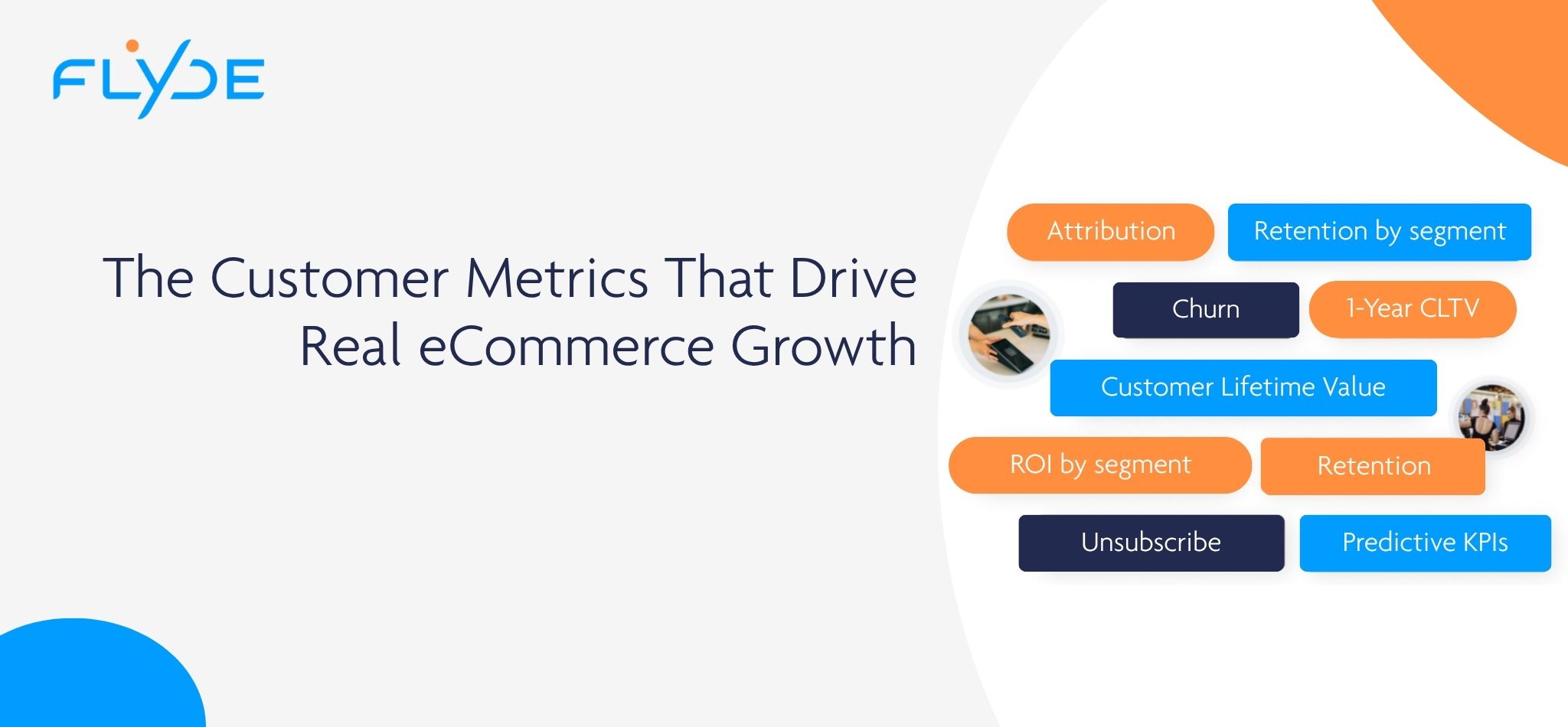
Those metrics are:
CLTV (Customer Lifetime Value)
How much revenue or margin a customer generates across their entire relationship with your brand. Without this number, it is impossible to know how much you can reasonably spend to acquire or retain a customer. As Miralda puts it directly: without CLTV, you do not know whether you are growing or destroying value.
Retention Rate by Segment
Not overall retention, but retention within your most valuable segments. A 5% improvement in retention can translate into 25% to 95% more profit, but only if you are retaining the right customers.
ROI by Customer Segment
The return on your marketing activity is not uniform across your customer base. Some segments respond well and are genuinely profitable. Others consume budget without generating real value. Without unified data, that distinction is completely invisible.
Omnichannel Attribution
Which channels and touchpoints are actually contributing to conversion and retention? The last-click model that most teams still rely on overvalues certain channels and ignores others entirely, distorting every investment decision you make.
Predictive KPIs by Customer
Knowing what has already happened is useful. Knowing what is likely to happen next is what allows you to act before a customer is lost or an opportunity closes.
WHY THESE METRICS ARE INVISIBLE WITHOUT A CDP
Every one of these metrics requires something most teams do not have: a unified view of the customer across all channels and touchpoints.
CLTV cannot be calculated accurately when online and offline purchases live in separate systems. Omnichannel attribution does not exist if digital behaviour and transactions are not connected. Predictive KPIs cannot be built without a complete history for each customer.
A Customer Data Platform (CDP) solves exactly that problem. Not because it is a reporting tool, but because it unifies the data that makes these metrics possible in the first place.
In FLYDE, the Customer 360 app gives you individualized visibility into the most relevant KPIs for each customer and predicts how those KPIs will evolve over the next twelve months. Omnichannel attribution connects every touchpoint to its real impact on conversion and retention. And predictive models let you anticipate behavior before it becomes churn or a missed opportunity.
3 QUESTIONS EVERY ECOMMERCE SHOULD BE ABLE TO ANSWER ABOUT ITS CUSTOMERS
Miralda offers a simple test. If your CDP, or whatever combination of tools you are currently using, is working properly, you should be able to answer these questions without waiting for someone to pull a report.
1. Do you know how much a customer who has been buying from you for over a year is worth on average, compared to someone who has only purchased once?
2. Which channel contributes most to retaining your highest-value customers, not to acquiring them, but to keeping them?
3. What percentage of your active customer base has a high probability of not buying again in the next ninety days?
If any of these questions draws a blank, the problem is not a lack of data. It is how that data is organized and activated. That is exactly what a well-implemented CDP resolves, and it is the starting point for moving from measuring activity to measuring business outcomes.
If you have already implemented a CDP but are not seeing real impact on your business, we’ve identified 5 patterns which stall the progress of a CDP. These patterns are common across business of different sizes and sectors. Read more here.
WANT TO GO DEEPER?
Download the ebook with Enrique Miralda’s full customer economics framework for free. Note: the ebook is currently available in Spanish only.
You’ve implemented your Customer Data Platform (CDP). The data is connected. The profiles are unified. The dashboards are live. And when someone asks what has actually changed six or twelve months later, the answer might sound like this: “We’ve connected the data sources.” “We’re unifying identities.” “We’re building segments.” “We’re setting up dashboards.”
All of that is infrastructure. And infrastructure is not why you invested in a CDP. You bought it to make better decisions, move faster and convert your most important asset, your customers, into a system that generates consistent, profitable growth.
The gap between those two realities is where many CDPs live and die.
THE REAL PROBLEM: INFRASTRUCTURE WITHOUT INTENT
Having a CDP is not a strategy. It is a starting condition.
A CDP creates the technical foundation for better decisions. But it does not make the decisions themselves. The companies that extract real, measurable value from their data, such as better retention, more efficient acquisition, and a higher margin, share one characteristic: they treat the CDP as a system to operate continuously, not a project to complete and hand over. That shift in how you think about it matters more than any feature set.
In his practical guide, CDP: Cómo convertir datos en negocio (How to Turn Data into Business), Enrique Miralda, ecommerce and digital strategy expert, puts it plainly: a CDP operated as a technology project will always end up as an expensive piece of furniture.
FIVE PATTERNS THAT EXPLAIN WHY CDPS STALL
Across different industries and company sizes, the same failure patterns appear over and over.
Use cases defined after deployment, not before.
The most expensive mistake in CDP implementations is building the data model before defining what decisions it needs to support. Teams connect sources, celebrate the integration, and then discover there is no clear answer to the question: what do we do with this now? If you cannot name three decisions you will make differently once your CDP is live, you are not ready to build it.
Insights that stop at the dashboard.
Segments get built. Behavioral data gets analyzed. Reports get shared in quarterly reviews. And then nothing changes in how customers are actually reached. Data without activation is storage. The value of a CDP is not what it knows, but what it triggers.
Miralda frames this as a four-step cycle: data, decisions, actions, and measurement. If your CDP is not running that cycle continuously, it is not just underused. It is a mere decoration.
Operational dependency on technical teams.
When every new segment requires a ticket and every activation requires IT involvement, the CDP stops being a competitive asset and becomes a bottleneck. The people who understand the customer need to be able to act on the data directly. When they cannot, adoption quietly dies.
Measuring activity instead of impact.
Opens, clicks and send volume are not business outcomes. They are proxies that feel safe because they are easy to report. Without some form of incremental measurement (understanding what changed because of an action, compared to what would have happened anyway), it is impossible to know whether a CDP is generating value or just generating noise.
Miralda labels this as the difference between saying “we did things” and “we generated revenue.”
No ownership, no system.
A CDP touches marketing, data, technology and in many cases, operations. Because it belongs to everyone, it frequently ends up owned by no one. Without an accountable owner, a clear operating process, and a regular cadence for reviewing and improving use cases, your CDP will drift toward irrelevance. And it’s not because the technology failed, but because no one kept driving it.
Miralda covers this in detail in his ebook, including a weekly operating model and a clear accountability structure.
SEVEN QUESTIONS TO ASSESS THE UTILITY OF YOUR CDP
These are not questions for a vendor evaluation. They are for an honest internal conversation.
1. Can you name three decisions you make better today because of your CDP?
2. Do you have at least one active use case with a measured, incremental business result?
3. Can your marketing team activate new segments without waiting on IT?
4. Is there one person who has real authority, clear accountability, and ownership of CDP outcomes?
5. Do you know which customers you should not be contacting right now?
6. Are you measuring incremental impact or just campaign activity?
7. Is your CDP part of a defined operating process or is it a tool people log into occasionally?
If several of these questions produce hesitation, the underlying issue is almost always the same: not the platform, but the absence of a framework for turning data into decisions and action on a repeatable basis.
GOING DEEPER: A PRACTITIONER’S GUIDE TO MAKING CDPS WORK
If you recognise any of these patterns, you already know where to find a structured path forward.
Enrique Miralda’s guide is available to download for free. Please note it is currently only available in Spanish.
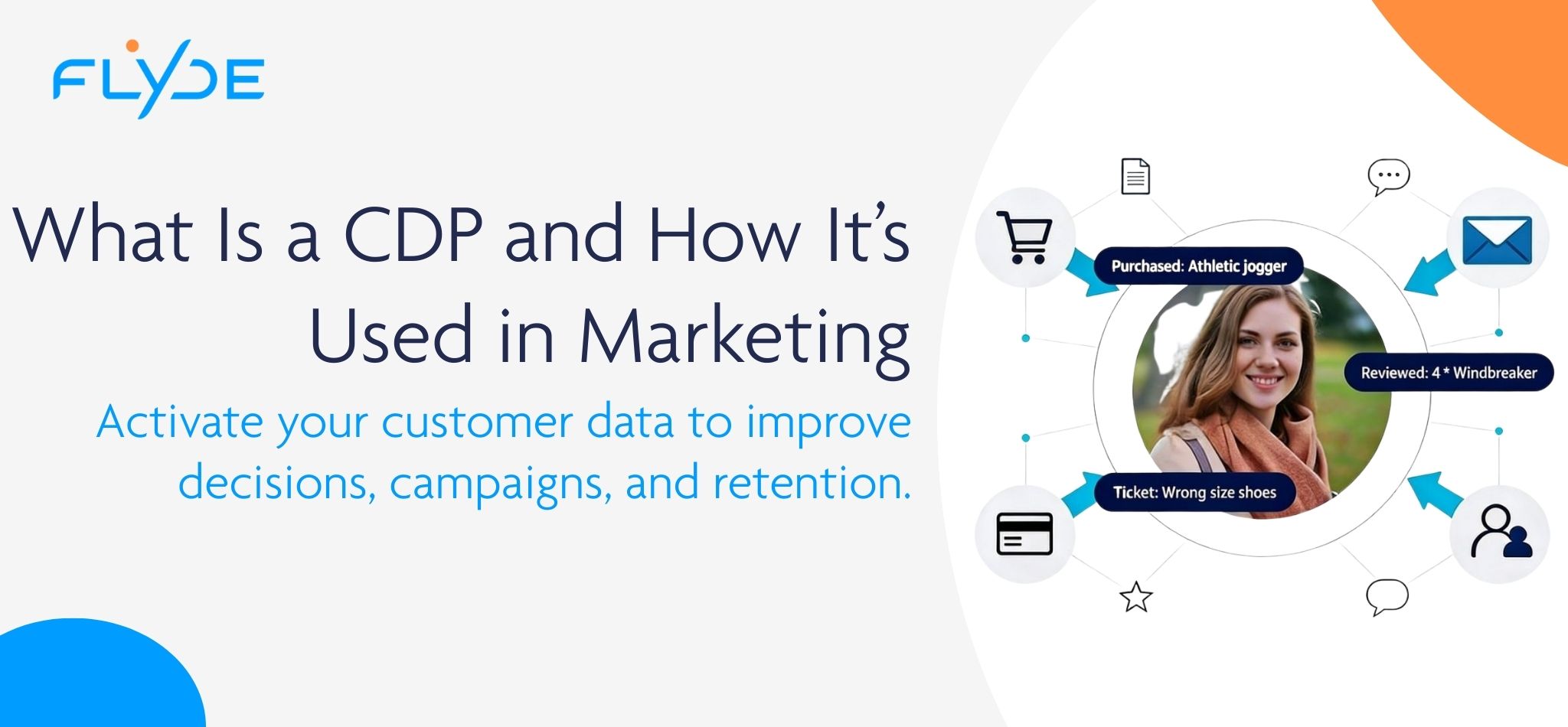
Most companies store customer data across multiple tools. The CRM records sales interactions. The email platform stores campaign history. The ecommerce system tracks orders. The customer support tool logs tickets. Each system has its own version of the customer. And none of them talk to each other.
The result is predictable: decisions based on partial information, marketing campaigns that ignore what customer support already knows, and customers receiving irrelevant messages because no one has a complete picture of who they are. The CDP exists to solve exactly that problem.
Understanding what a CDP is is only the first step. The real challenge is not just unifying data, but using it consistently to improve marketing decisions, retention, and campaign efficiency. In this series, we explore how to do that in practice.
WHAT IS A CUSTOMER DATA PLATFORM (CDP)?
A CDP, or Customer Data Platform, is software that collects customer data from multiple sources and unifies it into a single profile for each customer, primarily based on first-party data.
Unlike other data tools, a CDP is designed specifically to manage first-party data, meaning the data generated through your direct relationship with the customer. In simple terms, a CDP unifies data from all of your sources in order to reveal who each customer is, what value they represent for your business, and how likely they are to buy or churn.
The value doesn’t come from having this data, but from being able to use it operationally in marketing and business decisions.
HOW A CDP IS USED IN MARKETING?
Advanced segmentation
Rather than segmenting by basic demographic variables such as age, location or gender, a CDP lets you build audiences based on real behaviour: customers who have purchased more than twice in the last 60 days, customers showing high churn propensity based on usage patterns, high-value customers who haven’t engaged in weeks. These segments update dynamically, without manual exports.
Personalization at scale
With a unified profile per customer, messages can be adapted to each person’s real context: their history, their preferred channel, their stage in the customer lifecycle. Personalization stops being a one-off project and becomes part of standard operations.
Data activation in campaigns
The value of unified data comes from being able to use it where decisions actually happen. A bottleneck often forms between data and action: the marketing team identifies a segment they want to activate, requests it from IT, IT prepares it, and by the time the audience is ready, the context has changed. For companies with high customer turnover or short purchase cycles, this delay is especially costly.
A CDP removes that intermediary. Segments are built directly on unified data and sync automatically with execution channels. The email platform launches the campaign with the right audience, the paid media manager excludes customers who already purchased, the customer service system shows the customer’s full context before the agent picks up the phone. Everything runs on the same profile and updates every time the customer does something new.
Precise attribution
By unifying customer behavior across all touchpoints, a CDP helps you understand which channels and campaigns actually contribute to conversion—and which ones simply appear along the journey without influencing the decision.
HOW DOES A CDP WORK?
A CDP operates across three layers that work continuously.
Data ingestion
The CDP ingests data from all relevant sources: website, app, ecommerce platform, CRM, email tools, customer service system, point of sale where applicable. This ingestion can happen in real time or in batches depending on the need, and the CDP can process both structured data and behavioural events.
Profile unification
Once data is received, the CDP consolidates it into a single profile per person. This means resolving the customer’s identity across different identifiers such as email, phone number, user ID and navigation fingerprint, to ensure that interactions from the same person across different channels are attributed correctly and don’t create duplicate or contradictory profiles.
Data activation
The unified profile is made available to other systems. The marketing team can build segments and push them to their paid media platform. The email tool can personalise content based on the customer’s history. The customer service agent can see full context before responding.
CDP vs. CRM vs. DMP: WHAT’S THE DIFFERENCE?
It’s common to confuse these three technologies because they all work with customer data, but they serve different purposes, have different scopes, and are used by different teams.
What is a CRM?
A CRM (Customer Relationship Management) is a platform designed to manage relationships with customers and prospects. It centralizes key information such as contacts, sales interactions, and deal stages, and helps sales teams organize and track their pipeline.
What is a DMP?
A DMP (Data Management Platform) is a tool focused on audience management for advertising. It collects and combines data, primarily from third-party sources, to create highly specific segments that can be activated in marketing and digital media campaigns.
Summary of the three tools:
| Feature | CDP | CRM | DMP |
|---|---|---|---|
| Unified customer profile | ✓ | Partial | ✕ |
| Behavioral data | ✓ | Limited | ✓ |
| Transactional data | ✓ | ✓ | ✕ |
| Anonymous data | ✓ | ✕ | ✓ |
| Audience activation | ✓ | Limited | ✓ |
| Main use case | Marketing and personalization | Sales and customer management | Programmatic advertising |
| Data updates | Real-time | Manual / partial | Campaign-based |
The relationship between CDP and CRM is particularly worth understanding: they are not competitors. The CRM manages the commercial process and the relationship with known customers. The CDP provides the layer of behaviour and value that makes that process more intelligent. In many companies, the CDP feeds the CRM with context it couldn't build on its own.
CDP USE CASES
Personalizing retention campaigns
A fashion retailer with both ecommerce and physical stores uses its CDP to identify customers who are starting to disengage: fewer purchases over the past 90 days, lower interaction with campaigns, and no recent visits to the website or stores.
Before losing them, the retailer activates a targeted campaign for this segment. The message, channel, and incentive are tailored to each customer’s value, with product recommendations based on past purchases, early access to new collections, or a personalized offer to drive the next purchase.
Optimization of paid media campaigns: audience exclusion
An office supply retailer with physical stores and an ecommerce channel runs paid media acquisition campaigns. The problem: their advertising platforms only see what happens in the digital channel. A customer who bought in-store last week still appears as a prospect in the ads system and keeps receiving acquisition messages. Not only do the messages annoy the customer, but they also represent wasted spend for the company.
With a CDP that unifies data from physical stores and digital channels into a single profile, that customer is removed from acquisition audiences as soon as their purchase completes, regardless of where it happened. The exclusion is automatic and updates in real time. The budget that was being spent trying to convert someone who already converted gets redirected towards real prospects or towards loyalty campaigns for that same customer.
Customer behavior analysis: understand what makes a client stay
A gym chain notices that churn is concentrated in the first 60 days. The problem is that all new members look identical at sign-up, with the same membership fee and the same contract, but some disappear within weeks while others stay for years.
Using the CDP, the chain crosses first-30-day behaviour with long-term retention and finds the pattern: members who attend at least three times in their first week and take part in at least one group class before day 15 have a significantly higher 12-month retention rate than the rest. The pattern in the data is clear.
Armed with that insight, they redesign onboarding: new members receive specific communications pushing them towards those two behaviours in their first week. Not discounts or generic welcome messages, but actions designed to guide them towards the behavior that predicts long-term retention.
WHY CDPS MATTER FOR MODERN BUSINESSES
Omnichannel marketing
Customers interact with brands across multiple touchpoints, such as web, app, physical store, social media and customer service, and expect a consistent experience across all of them. Without a layer that unifies those interactions, consistency is impossible: each channel operates on its own incomplete version of the customer, unaware of what happened elsewhere.
Data-driven decisions
As marketing teams take on greater accountability for business outcomes such as retention, margin, and cost to serve, they need data that goes beyond campaign metrics. A CDP provides the foundation to measure real impact, not just activity.
A CDP helps teams move from fragmented data to more consistent and informed decisions.
Campaign efficiency
The ability to segment precisely, exclude people who shouldn't receive a message, and personalize based on real context reduces advertising waste and improves conversion without necessarily increasing budget.
ACTIVATE YOUR DATA WITH FLYDE
Having a CDP is the first step. Real value appears when data becomes concrete actions with measurable business impact.
FLYDE combines CDP technology with strategic and operational support to help companies see results in weeks, not months. The focus is on identifying the highest-return use cases from the start, executing them with rigor, and measuring impact incrementally, so that every investment decision is backed by real data, not assumptions.
If you want to explore how a CDP can apply to your specific context, Enrique Miralda's ebook, CDP: How to Turn Data into Business, on customer data platforms is a good starting point: it covers everything from the fundamentals to a 90-day roadmap with real results.
In the fifth episode of FLYDE Talks, Paco Herranz, founder and CEO of FLYDE, sat down with Enrique Miralda, an expert in digital strategy and ecommerce with over 20 years of experience. More than an interview, it was a dialogue between two professionals who work day-to-day with companies at very different stages of digital maturity. The conversation focused on why most companies don’t have a real customer strategy and what it takes to build one.
WHO OWNS THE CUSTOMER IN YOUR COMPANY?
If you ask most organizations who is responsible for the customer, the answer is usually silence. And according to Enrique Miralda, that silence is the clearest sign that no real customer strategy exists.
Customers are the primary asset in any business. Yet what typically happens is that marketing has one view, the CRM team has another, and the customer experience department limits itself to handling complaints. Each department manages its own version of the customer and those versions rarely match.
The result is that the same customer can receive contradictory messages from three different departments on the same day, without anyone realizing it. Paco reinforced this from his direct experience with FLYDE clients: the absence of a clear owner isn’t just an organizational symptom; it’s the most telling sign that no real customer strategy exists.
THE IMBALANCE BETWEEN ACQUISITION AND RETENTION
Enrique noted that around 70% of marketing investment goes towards acquiring new customers, with barely 30% directed at retention. This happens despite the fact that retaining a customer is five times more profitable than acquiring a new one.
And there’s an even more critical insight: unless a company has a gross margin above 45-50% or a very high average order value, its business will not be profitable until the second purchase happens. A new customer is not profitable the day they arrive. They become profitable when they come back.
Paco added another angle he sees repeatedly in FLYDE’s own sales process: often there are several departments talking to the customer through different channels, with no coordination, and none of them actually listening. The problem isn’t too much communication but rather the lack of a unified customer view to back it up.
CRM VS. CDP: THEY ARE NOT THE SAME THING
One of the most common misconceptions is that a CRM is enough to manage customer strategy. Enrique is clear: the CRM has a concrete and valuable function, but it has important limitations.
A CRM provides a snapshot of current customers, but it doesn’t work with anonymous users, has no real predictive capability, and doesn’t unify the customer view across all channels. A customer who buys in a physical store, on the website, and through an app can appear as three different people.
A CDP (Customer Data Platform) is designed to solve exactly that: unifying all customer information into a single profile, diagnosing behaviors, predicting future actions and prescribing the best strategies for each segment.
EVERY BUSINESS IS A FINANCIAL BUSINESS
Enrique is particularly critical of the lack of financial perspective in marketing and ecommerce teams. Measuring profitability through gross margin is a common mistake. What matters is the contribution margin, which deducts all real costs: payment commissions, shipping, packaging, returns and marketing campaigns.
It is perfectly possible to have a positive ROAS and still be losing money. Everyone making decisions about customers should be able to answer this question: at what point does this customer start to be profitable for my business?
THE CDP AS AN INVESTMENT, NOT A COST
For Enrique, there is no room for doubt: he knows of no more profitable investment in ecommerce than a well-implemented CDP. With the right agility, it is common to see a return that covers the platform cost within 60 to 90 days. In some cases, a single use case has generated enough margin to pay for the tool for two years.
The key is speed of implementation. Tools like FLYDE are designed so that business teams can operate with maximum independence from IT, activating use cases in weeks, not months.
CONCLUSIONS
Companies that build a real customer strategy share five characteristics:
- They have defined who owns the customer within the organization.
- They balance investment between acquisition and retention.
- They understand the difference between CRM and CDP, and use each tool for what it was designed for.
- They measure in terms of contribution margin, not gross margin or ROAS in isolation.
- They start with concrete use cases that demonstrate fast ROI, and scale from there.
The question every company should ask is not what new tool they need, but who is responsible for ensuring their customer is treated with excellence at every touchpoint.
DOWNLOAD ENRIQUE’S EBOOK
If this conversation has raised questions about how to implement a CDP, how to measure its return, or how to structure the use cases that generate the most value, Enrique Miralda has just published the book that answers exactly that.
CDP – Customer Data Platform: How to Convert Data into Business is a practical guide covering everything from the minimum technical requirements you should demand, to a 90-day roadmap with real use cases, contribution margin metrics and step-by-step numerical examples. It also includes chapters on AI applied to CDP, weekly operating models and a comparative guide to the leading platforms on the market.
This is not a book about concepts. It is a manual for going from “we have a CDP” to “the CDP is generating value.”
The ebook is currently available in Spanish.

Acquiring a new customer costs between five and twenty-five times more than retaining an existing one. And yet, most retail companies continue to direct the majority of their marketing budget toward acquisition.
And yet, most retail companies continue to direct the majority of their marketing budget toward acquisition, even though 65% of their revenue comes from just 8% of their most loyal customers.
The explanation seems obvious. Without acquisition, there is no business.
But framing client strategy as a choice between acquisition and retention is an oversimplification. The real problem is that many companies do not have a precise understanding of when a customer becomes profitable. And without that answer, any debate about budget allocation is, at best, an educated guess.
Striking the right balance between acquisition and retention depends on three factors that vary significantly across businesses: product margin, purchase type and the point in the customer cycle at which real value is generated.
For a premium furniture or appliance retailer, the cost of acquisition may be recovered on the first order. The customer arrives with the decision practically made, clear purchase intent and a high ticket value. In that case, the strategic priority is not necessarily to accelerate a second purchase, but to convert a good experience into a recommendation.
For a fashion brand investing in paid social and offering welcome discounts, the first purchase is likely not to be profitable. Profitability typically arrives with the second purchase, when the customer buys without an incentive.
For a jewelry brand or luxury label, the return can take years to materialize, sometimes not until the third or fourth transaction. Acquisition costs are high and purchase frequency very low. The key to profitability lies in the long-term client relationship.
Without understanding that profitability threshold, it is impossible to decide how much to invest in acquisition, how much in retention, and which levers to activate at each stage of the customer cycle. Yet many companies still cannot answer that question clearly.
WHY FINDING THE RIGHT BALANCE IS SO DIFFICULT
Measurement and attribution present significant challenges.
Customers typically interact with a brand across multiple platforms before making their first purchase. A social media ad, a recommendation from a friend, an organic website visit or an email can all be part of the same decision-making process.
The complexity increases further after the first purchase.
Imagine a customer who is satisfied with their order, joins the loyalty program, receives an email three weeks later, and returns to buy. What brought them back? The product? The loyalty rewards program? The email? A combination of all three?
The effects accumulate over time and rarely appear cleanly in any dashboard. Understanding them requires a longer view of the customer cycle and a different attribution logic.
This is why many marketing decisions are still made based on partial or short-term metrics. And when metrics are incomplete, investment tends to concentrate on what is most visible and easiest to measure: acquisition.
THE REAL COST OF IGNORING RETENTION
The well-known finding that acquiring a new customer costs between five and twenty-five times more than retaining an existing one appears consistently throughout the marketing literature and has been widely cited by Harvard Business Review.
A similarly striking finding comes from relationship marketing research. It is estimated that a 5% increase in customer retention can increase profits by between 25% and 95%, according to research by Frederick Reichheld of Bainand Company.
The potential impact is too significant to treat retention as a secondary priority.
But activating that lever correctly requires more than increasing the volume of CRM campaigns. It requires understanding precisely who your customers are, what value they generate, and where they are in the cycle.
And that is where many organizations run into another obstacle.
HAVING DATA IS NOT THE SAME AS HAVING CUSTOMER INTELLIGENCE
Today’s retail companies accumulate large amounts of information: purchase histories, web behavior, loyalty data, customer service interactions and email opens.
But having data does not mean truly knowing the customer.
In many organizations, information is fragmented across multiple systems. Purchase history lives in Shopify. Loyalty promotions in another platform. Browsing behavior in Google Analytics. Support interactions in Zendesk. Email campaigns in Klaviyo.
Each system knows something about the customer, but none of them actually knows the customer.
Without a layer that unifies those signals, it is impossible to have a clear picture of who that customer is, what interests them, and where they are in the cycle.
That is why the first step toward a solid client strategy is usually not segmentation or artificial intelligence. It is data architecture.
A Customer Data Platform (CDP) makes it possible to unify those sources into a single, actionable customer profile. It is not just a marketing tool. It is the foundation that allows any acquisition or retention strategy to operate with real business logic.
HOW METRICS ARE CONVERTED INTO BUSINESS DECISIONS
When customer data is centralized, segmentation can begin to answer questions that are relevant to the business. Which customers generate the most value? Who is at risk of churning? And who has the greatest growth potential?
Predictive models can identify early churn signals, such as drops in purchase frequency, absence of interaction or a declining average order value.
What distinguishes companies that grow sustainably is their ability to convert operational metrics into business decisions. Many teams still measure email open rates, click-through rates and volume of communications sent. These are useful metrics, but they rarely answer the questions that actually matter.
How many at-risk customers were recovered?
How many moved from a first to a second purchase as a result of a specific initiative?
How much did the lifetime value of customers acquired last quarter increase?
When analysis focuses on the complete customer cycle, the debate between acquisition and retention begins to lose its relevance. Both become levers within a single strategy.
ROADMAP FOR BUILDING A CUSTOMER STRATEGY
1. Identify when your customer becomes profitable. Do not assume it is the same for every business. Knowing the threshold precisely is the prerequisite for everything else.
A premium furniture or appliance retailer may recover acquisition costs from the first order. A fashion brand running paid social with a welcome discount rarely sees profitability on the first transaction: the threshold comes with the second purchase, the one made without an incentive. A jewelry or luxury brand may not see a return until the third or fourth transaction, sometimes years later. When acquisition costs are structurally high and purchase frequency very low, the bet is not transactional but rather relational.
2. Revisit the segmentation logic based on the business model.
For high-frequency businesses such as online supermarket or pharmacy, the priority is usually detecting early churn signals: small drops in frequency are warning signs that predictive models can identify before the customer is lost. For low-frequency businesses such as furniture or electronics, the key is to identify customers with the greatest potential for recommendation or to upsell at the right moment. If segmentation does not make this distinction, it is not serving the business.
3. Design initiatives for the critical moment in each business’s customer cycle.
For most ecommerce businesses, that moment is the transition between the first and second purchase, the most decisive and most neglected stretch. For high-frequency businesses, it is early churn prevention, where predictive intelligence adds the most value by acting on risk signals weeks in advance. For high-ticket businesses, it is the post-sale experience and the long-term relationship. The question is not “what campaign do we launch?” but “what does this segment need, in this type of business, at this specific moment?”
4. Define who owns the client strategy, with real authority over budget and KPIs.
In many organizations the customer belongs to several teams but to none in particular. Marketing, CRM and ecommerce each work on parts of the cycle, but no one has a complete view of the customer or direct responsibility for their profitability. In a business where the customer becomes profitable on the second purchase, someone has to be accountable for ensuring that second purchase happens.
5. Incorporate advocacy as a growth engine, especially in businesses where paid media shows diminishing returns.
A satisfied customer who recommends the brand can generate new customers at near-zero acquisition cost and with a retention rate higher than any paid channel. For high-ticket, low-frequency businesses, advocacy is not an add-on: it is the most efficient path to growth. For high-frequency businesses, it is the lever that closes the loop between retention and acquisition. In both cases, it is the most systematically overlooked element in marketing plans.
FLYDE TALKS 5
These questions will be at the center of FLYDE Talks 5, on 24 March at 6pm CET via LinkedIn Live, where FLYDE CEO and Founder Paco Herranz and digital strategy expert Enrique Miralda will discuss how to build a true client strategy in retail.
You can register for the event here. Kindly note that the session will be held in Spanish.


In the fourth episode of FLYDE Talks, Paco Herranz, founder and CEO of FLYDE, spoke with Álvaro Pariente, data and enterprise technology expert and founder and CEO of BEOC9, to analyze the key factors that will determine business success this year. The conversation explored crucial topics such as how to organize data, the role of CDPs (Customer Data Platforms), and why many companies are not seeing real results from artificial intelligence.
THE CRITICAL TRIANLGE: BUSINESS, DATA AND IT
Álvaro began by highlighting a structural issue affecting many organizations. For years, companies have been digitizing processes and collecting data across multiple systems. However, this transformation created a problematic divide between three departments that should be working together:
- IT: decides on architecture and systems
- Business: defines the “what” and how to impact the customer
- Data: often scattered between IT and business, with no clear owner
The result is predictable: data silos, lack of coordination, and multiple departments engaging the same customers as if they were entirely different companies.
The solution is not technological but rather organizational. Before investing in tools or implementing AI, companies need to align these three pillars internally and give them equal importance. Only then can they extract real value from their data.
THE REAL PROBLEM: ATTRIBUTION AND FRAGMENTATION
A perfect example of this lack of organization is conversion attribution. When multiple departments interact with a customer through different channels (paid media, email, etc.), each one claims the conversion as its own.
The problem becomes even more troublesome in fast-growing companies that are investing aggressively in acquisition, because proving the return on each channel is critical.
THE EVOLUTION OF CDPs
Álvaro explained how the market has evolved from MDM systems (Master Data Management) to the new generation of CDPs. MDM systems required long projects, complex integrations, and the creation of a centralized “Golden Record” that often became invasive for existing systems.
Modern CDPs offer a different approach:
- Less intrusive: they connect to existing systems without disrupting operations.
- Continuous data collection: they unify data from multiple sources in real time.
- Identity resolution: they build a single customer view without requiring a centralized record.
- Fast activation: they allow immediate use of that information in the right channels.
- Compatibility with your tools: they do not require a single-vendor infrastructure and can connect with Adobe, Salesforce, Braze, or other tools.
Paco emphasized the importance of this point: no single vendor can cover every use case a business needs.
THE UNCOMFORTABLE TRUTH ABOUT AI
This was the most critical point of the conversation. Álvaro was direct:
“Without data organization and data scale, AI, in my view, will not take you anywhere.”
The problem is not the AI model. The problem is the data.
WHY MANY COMPANIES ARE NOT SEEING RESULTS WITH AI
ChatGPT works because it has access to a massive encyclopedia of information on the internet. But when a company wants to apply AI to its business, it is not querying the internet. It is querying its own internal data.
And that is where things become complicated:
- If your data is not organized
- If your prompt is poorly structured
- If your systems lack coherent information
- If your data is fragmented into silos
The result will not be what you are hoping for, no matter how much money has been invested in sophisticated technology.
The companies seeing real value from AI all share one thing in common: they organized their data first (customer information, internal processes, organizational knowledge), and only then applied technology. Not the other way around.
AN EXAMPLE: SENTIMENT ANALYSIS
Paco shared a concrete case: a company with millions of customer interactions whose only measure of satisfaction was sending Net Promoter Score (NPS) surveys, which most people do not respond to.
The solution is clear if the data is organized: run those conversations through AI-powered sentiment analysis. The company already has all the information needed to determine whether a customer is happy, frustrated, or about to leave a negative review.
No new data is required. The data is already there. The only missing piece is applying the right technology on top of a well-organized data foundation.
SECURITY AND GOVERNANCE: NON-NEGOTIABLES
A critical point was emphasized: you cannot send private company data into a public LLM without proper safeguards. Doing so would expose employee and customer data.
The solution is to use models (OpenAI, Anthropic, Google) within a secure architecture that includes:
- Data governance policies
- Access control
- GDPR compliance in Europe
- Clear management of what data is served, what is exposed, and what is received
IMPLEMENTATION STRATEGY
The conversation also addressed how implementation timelines have changed. Álvaro was clear: 18-month projects are a thing of the past.
The strategy that works today is:
- Focus on one single use case (not seven)
- Implementation in a maximum of 2 to 3 months
- Measurable impact on a specific KPI (churn, lifetime value, RFM)
- Iterate and expand once value is proven
This approach has clear advantages:
- Reduces time and costs
- Makes ROI traceable
- Drives adoption and change within teams
- Results improve exponentially with each new use case
As Álvaro said: “If consulting doesn’t deliver value, and value is tied to KPIs, then we shouldn’t be there.”
THE GARTNER MAGIC QUADRANT
The conversation closed with an analysis of the recent Gartner Magic Quadrant for CDPs (2026), the third report since the category was created in 2024.
Key trends identified include:
- Expansion beyond marketing: CDPs are no longer only for segmentation and campaigns. They are increasingly being used for B2B use cases, customer service, sales, and operations.
- Composability as the standard: the ability to integrate with multiple systems without requiring a full single-vendor suite is becoming a baseline requirement.
- AI and natural language access: platforms that allow users to query data using natural language are enabling business users (non-technical teams) to extract insights without needing SQL.
- The importance of connectors: competition is being defined by the speed and quality of integrations. It is no longer acceptable for a connector to take three months when it should be as simple as “pushing a button.”
CONCLUSIONS: A ROADMAP FOR COMPANIES THAT WILL WIN IN 2026
The main lesson from FLYDE Talks Episode 4 is clear: the companies that integrate data, technology, and business strategy will be the true winners in 2026.
It is not about having the most advanced AI model. It is about:
- Organizing your internal structure so data, IT, and business teams work together
- Implementing a CDP that unifies information without being invasive
- Applying AI to your own data with proper governance and security
- Starting with specific use cases that prove ROI quickly
- Scaling iteratively
The question every company should ask is not “What new tool do I need?” but “How do I make my current investment deliver more value?”
HOW FLYDE CAN HELP
Is your company’s data ready for AI? At FLYDE, we will continue driving conversations that help organizations understand this new landscape and take advantage of AI within a secure, results-driven framework. Contact us to explore how you can leverage new technologies within your company.
The data ecosystem has undergone a decisive transformation in the last few years, reshaping the daily operations of virtually every business. The end of third-party cookies is no longer a looming threat; it is a concrete, operational reality. Privacy regulations are stricter. Generative AI is now embedded in the day-to-day workflows of most companies. And customers expect hyper-personalized experiences delivered with the highest standards of privacy and transparency.
In this context, Customer Data Platforms (CDPs) have become the essential infrastructure that supports modern marketing, customer experience and business intelligence.
Below are the trends that will truly define the CDP landscape in 2026.
1. THE CDP AS THE BACKBONE OF BUSINESS
With the deprecation of user-level cookie tracking and tighter consent regulations, the Customer Data Platform has become indispensable for understanding customer behavior. A CDP unifies first-party data from multiple sources (web, apps, physical stores, CRM, campaigns, customer service, etc.) and enriches it with demographic and contextual information. It resolves identities, builds 360º customer profiles, and enables accurate performance measurement.
But its role now extends far beyond marketing. CDPs increasingly support core business intelligence use cases, including:
- Demand forecasting
- Price and promotion optimization
- Multichannel sentiment analysis (including reviews)
- Customer lifetime value, churn, and acquisition modeling
- Omnichannel experience management across physical and digital environments
2. ARTIFICIAL INTELLIGENCE POWERED BY FIRST-PARTY DATA
AI has become the central engine for data activation and its rapid adoption is directly driving the strategic importance of CDPs. According to a Markets and Markets report, the global CDP market is expected to grow at a compound annual growth rate exceeding 30% in the period between 2025-2030, driven by rising demand for the technology.
AI is only as good as the data it consumes. Many companies that implemented AI without a strong first-party data foundation have had to rebuild their architecture around a CDP. Modern CDPs allow AI to generate predictive insights and personalized recommendations based on reliable, governed, unified data. As a result, business decisions become more accurate, timely, and contextual, boosting campaign performance, customer experience and ROI.
3. PRIVACY AND TRUST AS A COMPETITIVE ADVANTAGE
Stricter regulations and rising consumer concern over privacy have reset the industry’s priorities. Companies are responding in two ways:
- Building data architectures that are based on privacy-by-design
- Using a CDP to provide full transparency and traceability: where data comes from, how it is used, and by whom
Meeting regulatory standards, ensuring traceability and offering transparency do more than protect businesses legally; they build genuine competitive advantage. Customers reward trust, and organizations that treat privacy as a core operating principle cultivate stronger relationships with customers and long-term loyalty.
It’s no longer just about collecting information. It’s about earning trust.
4. USABILITY AND AUTONOMY FOR BUSINESS TEAMS
A CDP’s success no longer depends solely on technical expertise within IT. In 2026, the most effective platforms are combining power with accessibility: intuitive interfaces, automated workflows and visual tools that allow marketing, sales and business teams to work directly with data.
This autonomy removes bottlenecks, accelerates campaign activation, and turns complex datasets into strategic, actionable decisions, without relying on slow or highly specialized internal processes. The differentiator is no longer the technology itself, but the clarity and business relevance of the use case.
And adoption is becoming even easier. Modular CDPs are gaining traction: platforms in which companies activate only the components they need. This reduces the learning curve, eliminates unnecessary complexity and facilitates real adoption across teams.
5. REAL-TIME AS THE NEW OPERATING STANDARD
Updating profiles, segmenting audiences, and activating campaigns in seconds is now an expectation, not a differentiator. Real-time capability reshapes the customer relationship: businesses can personalize experiences instantly, respond to interest or churn signals in the moment, and optimize resources with greater precision.
Modern CDPs turn data into immediate action, closing the loop from insight to decision to execution in one integrated, efficient flow.
HOW FLYDE STANDS OUT
At FLYDE, we know companies want to generate real business impact without long technical processes. That’s why we focus on accelerating time-to-value, helping teams see results quickly. Our platform is intuitive, visual, and powerful, designed for use by marketing and business teams. And with personalized support from day one, every client unlocks the full potential of their data.
Contact us to schedule a conversation and discover how FLYDE can power your growth.
Data integration is the essential first step for any business looking to implement artificial intelligence technology. Everyone is talking about AI right now. Marketing campaigns that adapt in real time. Customer service that anticipates needs before they are expressed. Predictive models that make complex business decisions feel effortless. The possibilities sound endless. But here is the part that does not always make the headlines: AI cannot deliver results without the right foundation. That foundation is reliable, complete and accurate data.
According to Gartner’s 2025 Hype Cycle for Artificial Intelligence Goes Beyond GenAI, 57% of organizations believe that their data is not AI-ready. When customer data is scattered across platforms, presented in disconnected reports, and divided into silos, no algorithm, no matter how advanced, can make sense of it. The Gartner report also indicated that less than 30% of AI leaders report that their CEOs are satisfied with the return on AI investments. When AI ambitions clash with siloed data ecosystems and infrastructure constraints, AI will fail to deliver results.
THE HIDDEN WORK: DATA INTEGRATION
Many organizations want to explore AI but quickly discover that their data is not ready. Information lives in CRMs, ecommerce platforms, analytics tools, and support systems. Without a single source of truth, it is impossible to build accurate models or generate reliable insights.
The less glamorous side of AI innovation is the behind-the-scenes work of data integration. Without centralizing data, records are incomplete or duplicated, transactions are disconnected from behaviors, and marketing touchpoints are measured in isolation. The result is noise, not intelligence.
Data integration means more than storing data in one central place. It means connecting, cleaning, and structuring information across all your businesses’ systems, applications, and data sources into a unified, usable format. This unified dataset transforms fragments into full customer profiles. It reveals the journey from the first interaction to the most recent purchase. Most importantly, it provides the context that makes AI accurate and actionable.
HOW FLYDE CAN HELP
The FLYDE Customer Data Platform (CDP) is designed to solve the integration challenge and prepare data for AI-driven use cases. FLYDE connects your data sources, from marketing tools and sales systems to customer service platforms. It collects, standardizes, and combines data into complete profiles that update in real-time.
Once centralized in FLYDE, your data is no longer trapped in spreadsheets or siloed reports. It becomes AI-ready data, structured for insights and accessible across your business units.
With FLYDE you can:
- Build a reliable single view of each customer.
- Feed clean, structured data into AI and machine learning models.
- Provide your marketing, sales, and operations teams with a consistent source of truth.
Once your data is unified, AI can finally do its job. Some of the most powerful opportunities include:
- Smarter personalization: recommending the right product at the right moment, based on actual behavior patterns.
- Leveraging predictive models: forecasting churn, customer lifetime value, or seasonal demand with confidence because the data feeding the model is complete.
- Optimized decision-making: allocating marketing spend where it produces measurable ROI, informed by a complete customer journey.
- Operational efficiency: reducing duplicated work and aligning teams around consistent data.
THE REAL AI MINDSET
AI is not the starting point. It is the outcome of disciplined data integration and unification. Businesses that centralize and structure their data today will be the ones leading with AI tomorrow. Without that preparation, even the most advanced algorithms will fail to deliver meaningful results.
So, if you are excited about AI, and who is not, start with the foundation. With FLYDE, you will not just join the conversation about AI. You will be ready to put it into action. Contact us to schedule a demo and we can show you the possibilities your data holds for AI implementation.