
Category: Customer Experience

In this episode of FLYDE Talks, Luis Serrano, Head of Growth at Real Madrid, sits down with Paco Herranz, Founder and CEO of FLYDE, to explore how the concept of Growth Marketing has evolved in an environment shaped by artificial intelligence, extreme personalization, and data privacy—and how it can be applied to the unique context of football.
With this new episode of FLYDE Talks, we continue to bring together leading voices from across the marketing world to discuss, clearly and without jargon, the ideas that are transforming the industry today.
WHAT DO WE REALLY MEAN BY GROWTH?
Paco opens the conversation with a question every growth professional has asked themselves: What exactly do we mean by “growth”?
For Luis, the term has expanded significantly. What once referred to scaling digital channels now means understanding growth from a holistic perspective: digital and physical channels, data, user experience, and brand value.
“We’re no longer just talking about digital channels,” he says. “We’re talking about everything.”
Growth is no longer about funnel optimization alone; it’s about connecting every touchpoint between the user and the brand under one unified objective.
REAL MADRID’S ‘NORTH STAR’: THE SATISFIED MADRIDISTA
Paco and Luis agree that successful growth depends on having a clear metric that guides the overall strategy: the famous North Star Metric.
At Real Madrid, that North Star is the satisfied Madridista: a fan who trusts the club, shares their digital identity, and enjoys a full, consistent experience across online and offline channels. The satisfied Madridista is the “guiding star” behind every growth initiative at the club.
To measure that satisfaction, the team tracks KPIs that range from fan acquisition and retention, including engagement metrics, NPS (Net Promoter Score), and churn. The challenge lies in turning every interaction into a source of value, for both the fan and the brand.
‘ONE FAN, ONE EXPERIENCE’: UNIFYING DATA FOR ONE-ON-ONE PERSONALIZATION
From FLYDE’s perspective, growth can only scale if data is unified. It starts with data collection—first, second, and third party—and continues with data unification to create a single customer profile, the key to enable precise segmentation, activation, and measurement.
The unified customer profile is the foundation of any growth strategy. It allows teams to move from analysis to action: building micro-audiences, orchestrating omnichannel campaigns, and, most importantly, measuring attribution accurately. The real challenge isn’t gathering more data, but rather knowing where each impact truly comes from.
Real Madrid applies this philosophy with a simple vision: One fan, one experience.
From email to app, store to stadium, every interaction is tracked and optimized to deliver the best possible experience within the club’s ecosystem.
The ultimate goal is true micro-segmentation, evolving from “many-to-many” to “one-to-one,” offering each fan exactly what they need. As Luis puts it simply: “If I have a cat, why are you offering me dog food?”
Read more about the importance of data unification.
‘SEO IS NOT DEAD, AND GEO IS SEO.”
“SEO isn’t dead—and GEO is SEO.”
Through experiments with LLMs and metasearch engines, Luis found that generative AIs don’t search websites directly—they search search engines. In other words, for an AI to index your content, you still need to rank well on traditional search engines first.
So optimizing for visibility in AI results still means doing SEO: paying attention to microformats, structured data, and quality content. New tools, like Adobe’s LLM Optimizer, can even estimate how readable and indexable your content is for AI.
The takeaway is clear: the future of organic traffic will be hybrid and those who master SEO today will remain visible in the age of AI. At least based on what we know today.
MACHINE LEARNING AND GENERATIVE AI: THE NEW MARKETING DUO
Luis asks Paco how FLYDE integrates AI, and Paco explains that for him, AI isn’t a trend but a natural evolution of data-driven marketing.
FLYDE uses Machine Learning for key tasks:
- Measuring KPIs
- Detecting customer value patterns and projections
- Predicting churn
- Recommending products or audiences
On top of that, FLYDE has developed Brain, a generative AI layer across the platform. Brain acts as a data assistant, enabling any user, technical or not, to interact directly with their data ecosystem: building audiences, suggesting actions, analyzing campaigns, or even generating complex queries.
Its mission is to democratize access to data and remove the “blank page fear.”
As Luis jokes: “AI is like a shrimp cocktail—we have so many things to pick from that we don’t know where to start.”
THE CDP: THE NATURAL EVOLUTION OF THE CRM
Both speakers agree that a Customer Data Platform (CDP) like FLYDE is the strategic backbone that ties everything together.
At Real Madrid, the CDP is built around the Madridista Community, integrating data from e-commerce, the app, the Bernabéu tour, RMP Play, social media, and even in-stadium activity.
Thanks to this integration, the club can microsegment and activate data in real time. For instance, if a user is near the stadium, the system can trigger a personalized app notification with an offer or reminder.
The result is a coherent, contextual, and measurable experience—where data powers emotion.
Contact us to learn more about what the FLYDE CDP could do for your business.
PRIVACY AND REGULATION: GROWTH WITH RESPECT FOR THE USER
The new era of marketing comes with a non-negotiable condition: privacy.
Luis emphasizes that Real Madrid applies a strict transparency policy because trust is part of the fan experience itself.
Meanwhile, FLYDE advocates for ethical data usage. Its technology supports privacy-safe attribution using inferred data (such as average age, income level, or household type) to improve performance without compromising user trust.
The goal isn’t to know more, but to use what we already know better.
TOWARD A MORE HUMAN, MEASURABLE MARKETING
Growth marketing in 2025 operates at the crossroads of AI, CDPs, and customer experience.
But beneath it all lies a single principle: brands grow when they understand that data only matters when it creates satisfaction, trust, and real value.
Paco leaves us with an important conlcusion. Sustainable growth is born from the connection between data and people—and when done right, that connection is the future of marketing.

Success starts behind the scenes. While marketing, sales, and product innovation often steal the spotlight, inventory management can make or break your profitability and customer experience.
Think of your stock as a dynamic, strategic asset. Managed well, it fuels growth. Neglected, it quietly drains your resources and undermines your business.
THE COSTS OF INVENTORY MISMANAGEMENT
Poorly managed stock has immediate and costly consequences:
- Stockouts: A customer is ready to buy, but the item isn’t in stock. That’s not just a lost sale; it’s a missed opportunity and a negative customer experience. According to a study carried out by the IHL Consulting Group, an estimated $1.2 trillion in global retail sales was lost in 2023 due to stockout.
- Excess inventory: You’re tying up capital, crowding your warehouse, and risking spoilage, theft, or obsolescence. Overstock quietly erodes your bottom line. The IHL Group estimated that excess inventory cost retailers about $562 billion in 2023 due to markdowns and obsolescence.
- Inefficient operations: Poor stock management leads to delays, fulfillment mistakes, and disrupts workflows. The consequences in terms of employee productivity and job satisfaction can also be far-reaching.
THE BENEFITS OF SMART STOCK MANAGEMENT
According to the Institute for Business Forecasting, a 15% increase in inventory forecasting accuracy translates into a 3% increase in earnings before interest and tax (EBIT). Great inventory management is strategic. When done right, it delivers:
- Increased customer satisfaction: Reliable stock availability builds trust and keeps customers coming back.
- Reduced costs: You’ll be able to avoid surcharges for rush shipping, unnecessary storage fees, and waste from obsolete stock.
- Better cash flow: Freeing up capital from excess inventory gives you more flexibility to invest in growing your business.
- Efficient operations: With clear processes and real-time data, your team can move faster and make fewer mistakes.
- Smarter decisions: Accurate inventory data allows you to make smarter, data-driven business decisions. It helps guide pricing, purchasing, and marketing based on real demand.
THE ROLE OF TECHNOLOGY
Fortunately, artificial intelligence (AI) and machine learning (ML) are transforming inventory management by enabling more accurate demand forecasting. Demand forecasting is the practice of using historical data, market trends, and advanced analytics to predict future customer demand for a product or service. It empowers businesses to make smarter decisions across inventory, production, staffing, and budgeting—ultimately reducing waste, avoiding stockouts, and improving operational efficiency.
AI/ML-powered demand forecasting delivers key advantages for inventory management, including:
- Real-time visibility: Instantly see what’s in stock, where it is, and what needs replenishing.
- Automation: Streamline purchasing, receiving, and fulfillment processes to boost efficiency and reduce errors.
- Advanced analytics: Detect trends, optimize inventory levels, and identify bottlenecks or slow-moving stock.
- System integration: Centralize data from sales, finance, and e-commerce platforms. A Customer Data Platform (CDP) like FLYDE can help unify and enrich this data for smarter forecasting.
INVENTORY MANAGEMENT HEALTH CHECKLIST
How effective is your inventory management system? If you answer “no” to several of these questions, it might be time to rethink your approach.
Data & Visibility
- Can you see inventory levels in real time across all channels and warehouses?
- Do you have a centralized view of customer demand trends?
- Is your inventory data integrated with sales, marketing, and finance systems?
Forecasting & Planning
- Are your forecasts based on historical data and real customer behavior?
- Are your forecasting models updated regularly?
- Can you confidently anticipate when you will encounter a spike or a lull in demand?
Efficiency & Operations
- Is your restocking process automated (or is it manually triggered)?
- Are fulfillment mistakes (e.g., wrong items, delayed shipments) a rare exception?
- Do you know your inventory turnover rate?
Financial Impact
- Are you confident that your inventory is not tying up more capital than necessary?
- Are you able to avoid paying extra fees for expedited shipping or unnecessary storage?
- Does your team have fast access to accurate data to make stock decisions?
HOW FLYDE CAN HELP
To accurately forecast demand and optimize inventory, a Customer Data Platform (CDP) like FLYDE is essential for consolidating data from various sources.
FLYDE centralizes data from touchpoints across paid media, CRM, social, email, web navigation, and offline events. Whether you’re working with dozens of fragmented sources or just trying to get a full view of the customer journey, FLYDE brings your data together and enriches it with socio-demographic and interaction data. With FLYDE’s ML algorithms, you’ll be able to analyze the behavior of your customers, observe in real time how their movements affect the demand for your products, and anticipate future demand.
Contact us to schedule a demo to find out how FLYDE approaches demand forecasting in our easy-to-use Customer Data Platform.

Marketing one-to-one is the latest way of developing marketing strategies, which involves practicing the highest level possible of personalization towards your customers. This high level of personalization is already being carried out by many companies through various channels, such as social media ads, email marketing, website personalization, and offline marketing.
By leveraging customer data and machine learning, marketing one-to-one enables companies to create personalized experiences that distinguish their brand from competitors and boost sales.
How to carry out Marketing one-to-one strategies?
To carry out marketing one-to-one strategies, data is fundamental. Once this data is obtained, it needs to be actionable. Here are four simple steps to follow:
-
-
- Know your customer: To develop this type of strategy, you need to know your customers’ preferences in terms of buying habits, content, and products. Collect every piece of data available for each customer, such as their demographics, purchase history, and engagement with your brand.
- Know your product: Like with customers, you need to know why each product is liked by each customer or why it isn’t, and what it can bring them.
- Know the effect of your campaigns: By analyzing historical data, you can determine the impact of each campaign on each of your customers and products.
- Develop original personalized content: Once you’ve analyzed customer and product data, you should be able to develop unique, appealing content for each customer depending on their wishes and needs.
-
What technology do I need to carry out a Marketing one-to-one Strategy?
To carry out marketing one-to-one strategies, a Customer Data Platform (CDP) is a critical technology for retailers. A CDP allows companies to store every piece of data related to customers, sales, campaigns, and any other useful data for your company’s purposes. With the help of artificial intelligence (AI), a CDP can cross-reference this data to obtain 360 profiles of your customers. These profiles, combined with AI, allow you to hyper-segment, personalize, and predict future behaviors of your customers.
An example of a Data-Driven Marekting one-to-one strategy
For example, if you are a fashion retailer, you can use the data mentioned before to understand your customers’ preferences, such as the size of your customer, the type of clothes they like, and the amounts of money they usually spend.
By analyzing customer behavior during specific events, such as special holidays or sales events, you can adjust your marketing campaigns to match their behavior. If a customer tends to buy multiple items during a particular event, you can recommend similar products or offer a discount for a bundle purchase. This type of personalized experience is what customers demand today, and it can lead to increased customer satisfaction and loyalty.
WHY FLYDE?
Do you want your company to move on to the next level? A CDP is the key tool that will allow you to maximize the potential of your data and grow your business. Having control over all your data is now very simple.
Moreover, if you do not have IT or Data Scientist teams, this tool will allow you to outsource this function. And if you have them but want to reduce their workload and give more autonomy to your marketing and business teams when it comes to working with data, implementing an easy-to-use CDP would be the best option for your company. It will allow any single member of your company to use it, as this softwares are prepared for them.
Start taking control of your data today.
Schedule a meeting with one of our experts and discover how FLYDE can help your company achieve its goals.

As the world becomes increasingly competitive, companies must focus on customer satisfaction and loyalty to succeed. While customer acquisition is essential for growth, customer retention is even more critical. Retaining existing customers is essential for the long-term health of any business, as loyal customers tend to spend more, refer more, and cost less to retain.
In this blog, we will discuss marketing retention vs. acquisition and why current trends show that retention is much more important. We will also explore how a Smart Customer Data Platform (CDP) can help companies boost retention.
The importance of Customer Retention
The cost of acquiring new customers is significantly higher than retaining existing ones. According to a study by Harvard Business Review, increasing customer retention by just 5% can increase profits by 25-95%. This is because loyal customers tend to spend more, refer more, and cost less to retain.
Additionally, loyal customers provide valuable feedback and can help businesses improve their products and services. Therefore, it is essential for companies to focus on retaining existing customers.
Customer Retention vs. Customer Acquisition
While customer acquisition is necessary for growth, it should not come at the expense of customer retention. Many companies make the mistake of focusing too much on acquiring new customers and neglecting existing ones. However, research shows that companies that focus on customer retention tend to be more successful in the long run. Customer retention should be a top priority for any company that wants to grow and thrive.
The benefits of focusing on retention over acquisition
Focusing on customer retention over acquisition can provide a number of benefits to companies, including increased customer lifetime value (CLV), improved customer loyalty, and reduced marketing costs. By retaining existing customers, companies can increase CLV by encouraging repeat purchases and reducing churn. Additionally, loyal customers tend to refer others to the company, which can help reduce marketing costs associated with customer acquisition. By prioritizing retention, companies can create a positive cycle of growth that leads to long-term success.
How a Smart CDP can help boost retention
A Smart CDP can provide a comprehensive view of a company’s customers, allowing them to personalize marketing messages, improve customer service, and identify opportunities to upsell and cross-sell.
For example, let’s say a retailer collects data on a customer’s purchase history, browsing behavior, and preferences. With a Smart CDP, the retailer can use this data to send targeted marketing messages based on the customer’s interests and behavior. They can also use the data to recommend complementary products, provide personalized promotions, and improve customer service by addressing the customer’s specific needs and concerns. By using a Smart CDP, the retailer can create a more personalized and engaging experience for their customers, which can lead to increased loyalty and retention.
WHY FLYDE?
Do you want your company to move on to the next level? A CDP is the key tool that will allow you to maximize the potential of your data and grow your business. Having control over all your data is now very simple.
Moreover, if you do not have IT or Data Scientist teams, this tool will allow you to outsource this function. And if you have them but want to reduce their workload and give more autonomy to your marketing and business teams when it comes to working with data, implementing an easy-to-use CDP would be the best option for your company. It will allow any single member of your company to use it, as this softwares are prepared for them.
Start taking control of your data today.
Schedule a meeting with one of our experts and discover how FLYDE can help your company achieve its goals.

Understanding your customers’ needs and desires is essential to building a successful business. However, it’s not enough to simply ask your customers what they want. To truly understand their needs, you must identify the jobs or tasks they are trying to accomplish. This is where the Jobs-To-Be-Done (JTBD) framework comes in.
In this blog, we’ll see how to improve your JTBD strategy with a Customer Data Platform (CDP). By using a CDP, you can gain a more comprehensive understanding of your customers and their behaviors, which can help you improve your JTBD strategy.
Why Understanding JTBD Is Crucial for Your Business
Jobs-To-Be-Done (JTBD) is a framework that helps businesses understand the needs and desires of their customers by focusing on the jobs or tasks that customers are trying to accomplish. By understanding your customers’ JTBD, you can design products and services that meet their needs and differentiate yourself from competitors.
How to Improve Your JTBD Strategy with a CDP
A Customer Data Platform (CDP) is a data management tool that allows you to collect, unify, and analyze customer data from multiple sources. By using a CDP, you can gain a more comprehensive understanding of your customers and their behaviors, which can help you improve your JTBD strategy.
Here are four ways to improve your JTBD strategy with a CDP:
-
-
-
- Collect and unify customer data from multiple sources: A CDP allows you to collect and unify customer data from multiple sources, giving you a more comprehensive view of your customers.
- Analyze customer data using the JTBD framework: Using the JTBD framework, you can analyze customer data to identify the specific jobs your customers are trying to accomplish.
- Personalize marketing and product recommendations: By using the CDP to personalize your marketing and product recommendations, you can better meet your customers’ JTBD and increase engagement and sales.
- Optimize inventory to better meet customer needs: By understanding your customers’ JTBD, you can optimize your inventory to better meet their needs, reducing waste and improving your bottom line.
-
-
Case Study – How could a retailer improve their JTBD strategy with a CDP?
A retailer uses a CDP to collect and unify customer data from multiple sources, enabling them to gain a comprehensive view of their customers and their behaviors. Using the JTBD framework, the retailer analyzes the data to identify the specific jobs their customers are trying to accomplish when they shop for clothes, such as looking for stylish and fashionable clothes, prioritizing comfort and functionality, or finding clothes for specific occasions.
The retailer uses the CDP to personalize their marketing and product recommendations to better meet their customers’ JTBD. By creating targeted email campaigns and personalized product recommendations, the retailer increases customer engagement and sales, leading to higher customer loyalty and repeat purchases.
Additionally, the retailer is able to optimize their inventory to better meet their customers’ needs, reducing waste and improving their bottom line. In this way, using JTBD and a CDP can help fashion retailers to better understand their customers and improve their business results in a highly competitive industry.
Conclusion and Next Steps
In conclusion, understanding your customers’ JTBD is essential to designing products and services that meet their needs. By using a CDP to collect, unify, and analyze customer data, you can gain a deeper understanding of your customers and improve your JTBD strategy. To get started, consider implementing a CDP and using the four strategies outlined in section two to improve your JTBD strategy. With a more customer-centric approach, you can differentiate yourself from competitors and build stronger, more loyal customer relationships.
WHY FLYDE?
Do you want your company to move on to the next level? A CDP is the key tool that will allow you to maximize the potential of your data and grow your business. Working like the big multinationals in the market, which already have this type of software, and having control over all your data is now very simple.
Moreover, if you do not have IT or Data Scientist teams, this tool will allow you to outsource this function. And if you have them but want to reduce their workload and give more autonomy to your marketing and business teams when it comes to working with data, implementing an easy-to-use CDP would be the best option for your company. It will allow any single member of your company to use it, as this softwares are prepared for them.
Start taking control of your data today.
Schedule a meeting with one of our experts and discover how FLYDE can help your company achieve its goals.

2022 has been a key year for Customer Data Platforms. According to data provided by Deloitte, high growth brands are leading this change, with 61% moving to a first-party data strategy, while just 41% of low-growth brands are doing so.
The prohibition of third-party cookies and the obligation to use own data or customers who demand increasingly personalized experiences are some of the reasons that have driven this growth, which is expected to continue in 2023.
But what else can we expect? Here are 4 trends that will shape CDPs in 2023:
1. Increased adoption of CDPs by companies
Omnichannel strategies
The arrival of COVID-19, the new ways of buying (ROPO, Showrooming), or the constant raise of online buying, are some of the causes of the increased need of companies to develop omnichannel strategies, in order to unify their channels and their customer data through the whole brand.
Customers demand a better customer experience
Communication and generalized customer treatment is a thing of the past. Customer experience has positioned itself as a key factor for customers to stay with a brand or abandon it to the point where 86% of consumers would be willing to pay more if it meant a better and more personalized customer experience.
Obtaining relevant insights from Customer Data
Personalization and digital transformation also means receiving much larger amounts of data from our customers. Therefore, it becomes necessary to have a system that stores, organizes and processes data properly.
2. The Customer Data Platform (CDP) concept takes hold and is divided into subcategories.
While it is true that there are markets such as the U.S. where this type of platform is already well established, there are others where CDPs are just beginning to gain momentum.
At the moment, according to the CDP Institute’s Member Survey 2022, more than 60% of clients understand that the main functionalities of this type of platform are unified views of clients and the loading of data from different sources.
The year 2023 is expected to serve as a turning point and leave behind doubts about what these platforms are, what they do and how they can help a company. In the same way, it is estimated that a greater expansion of the knowledge of these platforms and their benefits will help the implementation in companies to understand how they can fit them into their MarTech strategies.
It is also expected that vendors will begin to differentiate into subcategories (pure data, analytics and campaigns) to help customers quickly identify capabilities and benefits.
3. Increased concern for data privacy
41% of consumers globally say their trust in digital service providers’ ability to keep personal data secure has decreased. By storing data in a Platform regulated under the strict GDPR protection will ensure a much safer environment for Customer’s Data.
We know how important it is to protect your customers’ data. That’s why at FLYDE we comply with legal and data protection obligations. You can find out how here.
4. Easy to use CDP platforms
The complexity of analyzing large amounts of data from different sources and processing them has made most of the CDP platforms on the market very technical. While it is true that there are companies with large IT teams, we can also find others in which the burden of these actions falls on teams with little technical knowledge that make it very difficult to use these tools properly.
Some suppliers are opting to facilitate some of the tools that make up their platforms, although there is still a long way to go as these changes require time and investment. However, it is still important: CDP platforms are becoming more and more transversal to all company departments. Sharing unified profiles, sharing data, cross-referencing and processing them in real time or generating strategies from them are just some of the common processes that we can find in any company on a daily basis.
For this reason, marketing and sales professionals, among other departments, are looking for greater autonomy when generating campaigns, cross-referencing data, etc., and thus avoiding funnels and waiting times.
WHY FLYDE?
Do you want your company to move on to the next level? A CDP is the key tool that will allow you to maximize the potential of your data and grow your business. Working like the big multinationals in the market, which already have this type of software, and having control over all your data is now very simple.
Moreover, if you do not have IT or Data Scientist teams, this tool will allow you to outsource this function. And if you have them but want to reduce their workload and give more autonomy to your marketing and business teams when it comes to working with data, implementing an easy-to-use CDP would be the best option for your company. It will allow any single member of your company to use it, as this softwares are prepared for them.
Start taking control of your data today.
Schedule a meeting with one of our experts and discover how FLYDE can help your company achieve its goals.

A Customer Data Platform is a global platform so many departments from many sectors can benefit from it. In fact every single department of the company Customer-Related will end up making the most of it.
As many different departments would use it, it is crucial for it to be accessible. This is why an easy-to-use CDP is vital for a company to be able to become Customer-Centric. Start taking control of your Data.
Customer-Centric Data-Driven Companies
Becoming Customer-Centric is a priority for companies, as U.S. companies lose $136.8 billion per year due to avoidable consumer switching. The current competition for market share has become more fierce than ever before, and the need to become omni-channel, forced companies who were willing to become Customer-Centric to be Data-Driven, in order to understand such amounts of Customers Data.
This is where Customer Data Platforms fit into place. A Customer Data Platform is a Platform where you store and unify all of your customers data (1st, 2nd, and 3rd Party Data), and with the use of AI/ML obtain actionable insights, from your customer’s 360 profile.
We would next see the different benefits a CDP would provide to the different departments of a company:
Marketing Teams
- 360 Profile: unifying customer data in one platform and in real time, enables a complete customer profile, that can be afterward compared with the rest of customers/potential customers to obtain insights.
- Hyper Segmentation: the unification of basic, behavioral, attitudinal, and socio-demographic data would enable a level of segmentation never seen before. Segmenting by buying habits for example (ROPO, Showrooming, etc.).
- Personalization: with the 360 profiling of customers your company could start personalizing campaigns according to each customers needs (Personalized newsletters, emails, content in Social Media depending on your customers segment presence, etc.).
- Predictive models on the efficiency of each campaign on each customer: a CDP will help your company on predicting tendencies with AI/ML. One thing your marketing team could do is by adding up your past campaigns to your 360 customers profile, predict the future campaigns efficiency, by types of campaigns and by customers likes.
- Buyer Personas in real time: having your customer data unified and constantly renewing would enable a constant buyer persona of each product, or a picture of the personal characteristics of the preferred customer for each product.
- Omni-channel Customer Journeys: each channel of communication works different, but customers demand a full unified experience from brands. You would be able to track the customer journey through channels to activate a personalized omni-channel experience
- Forget about Third-Party Cookies: a tagging functionality in a CDP would help you track each individual customer through your website and add this information to their 360 profile.
- Geomarketing: unifying 3rd Party-Data (Socio-demographic) allow the 360 profile to be much more detailed. With this you would be able to see the differences between neighborhoods, seeking for the one that matches the most with your buyer persona, ML algorithms would help you on this task, in order to show you the best neighborhoods to sell each product.
- Dynamic Scoring: model that gives a rating from 1 to 10 of each individual’s customer engagement in real time, to see how campaigns are affecting them or the point they are at with your company in terms of engagement.
- Orchestrate campaigns: get the insights from your customers and afterword the CDP would enable you to orchestrate campaigns by sending this audiences, segments or profiles on to your different tools (email marketing, Social Media, advertising group, etc.).
Sales Teams
- Personalized Contact: contacting via email or phone with customers or potential customers is really tough but it would definitely be easier if your sales team had a 360 Profile (with the unification of 1st 2nd and 3rd party data) to have all of the information from your customer (behavioral, attitudinal, basic, etc.) while you do phone sales.
Logistic Operators
- Demand forecast models: being able to predict the demand with efficiency rates over a 95% would avoid stock outs.
Directors
- Full reports easy to read: in the same platform and with all of the data and insights obtained before you would be able to extract reports, graphs, and summaries of how your company is performing in terms of customer experience.
- Demand forecast models: know a year before the total demand your company would have in order to organize properly financially.
WHY FLYDE?
Do you want your company to move on to the next level? A CDP is the key tool that will allow you to maximise the potential of your data and grow your business. Working like the big multinationals in the market, which already have this type of software, and having control over all your data is now very simple.
Moreover, if you do not have IT or Data Scientist teams, this tool will allow you to outsource this function. And if you have them but want to reduce their workload and give more autonomy to your marketing and business teams when it comes to working with data, implementing an easy-to-use CDP would be the best option for your company. It will allow any single member of your company to use it, as this softwares are prepared for them.
Start taking control of your data today.
Schedule a meeting with one of our experts and discover how FLYDE can help your company achieve its goals.
There are new technological solutions constantly appearing for companies to take control over customer experience. But which one should I choose? Is there really a difference between this platforms?
In this blog we would analyze the differences between Customer Relationship Management (CRM) platforms, Data Management Platforms (DMP), and Customer Data Platforms (CDP). We would also the reasons behind the latest boom of CDPs in the US, with estimations rising up to a $15.3 billion market for 2026.
What is a CRM?
A Customer Relations Management platform, is a platform where you can store Basic Data from you leads. It is a must for any sales team, as it helps to store and structure information of your customers.
What is a DMP?
A Data Management Platform, is used to unify data in order to create and segment audiences, in really specific ways as the information integrated comes from different data sources.
What is a CDP?
A Customer Data Platform is a software that enables companies to unify every single piece of data obtained from customers (Including the data you have in your CRM), and unifies it with 3rd Party Data (or data obtained from the market in which you operate), to portray a 360 profile of your customers, in order to segment, personalize, and predict with the use of ML/AI.
Technological Evolution: From a CRM to a CDP
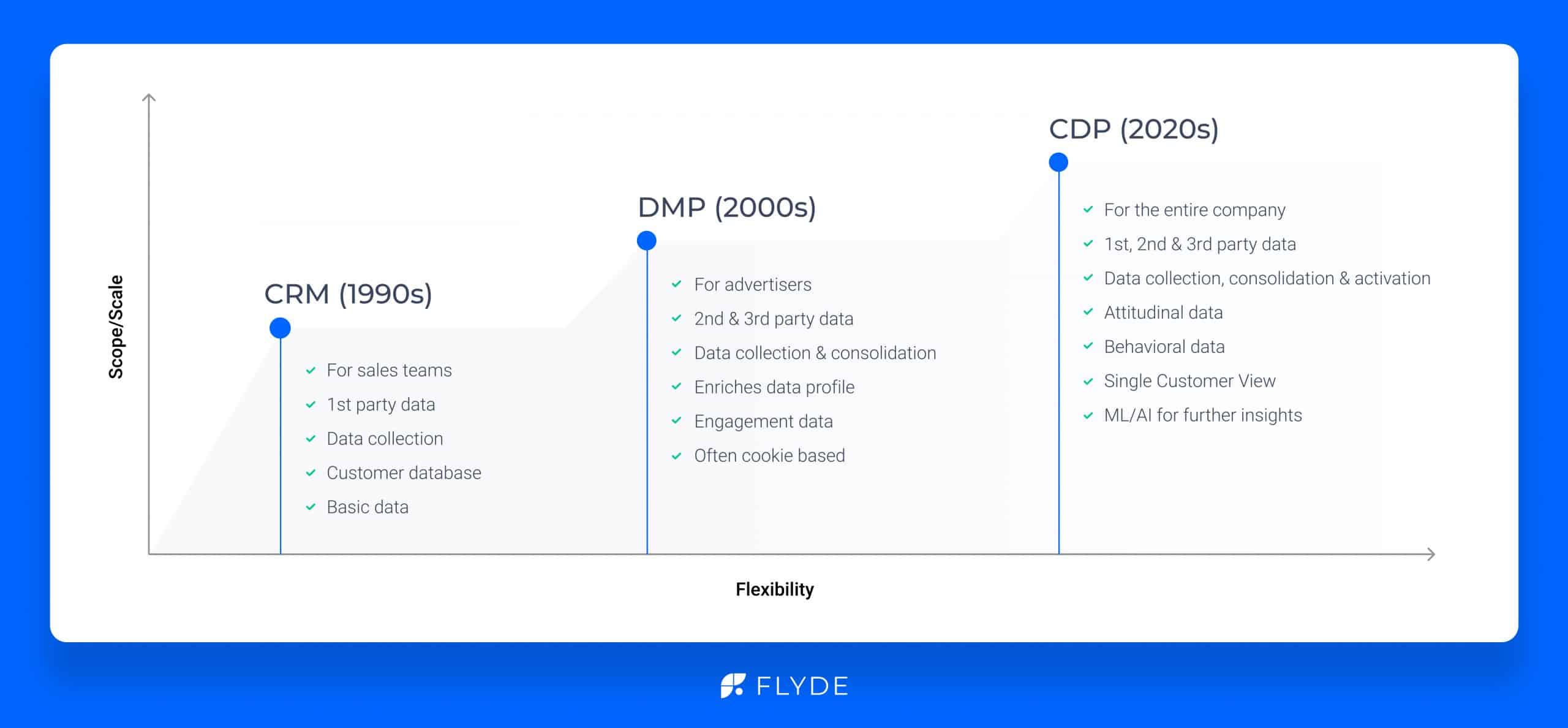
CRM (1990s)
CRMs emerged at the end of the last century as a way of storing basic customer information online. They were a very important step, sales teams were able to use them to have databases with leads and to carry out campaigns through them.
Today they are still a great help for lead management and lead storage, a great support for sales teams, but they do not cover all the needs of the contemporary company.
Nowadays, companies need to have a database that covers all possible customer data, not only basic information (age, sex, forms of contact, etc.), but they also need to enrich this information with behavioral and attitudinal data (product preferences, forms of purchase, contact times, favorite types of promotions, etc.).
DMP (2000s)
This is how the DMP (Data Management Platform) was born, with the intention of gathering all the information about your customers in a single platform, not only the sales data, but you could unify this data (extracted from a CRM), with behaviors and attitudes of your customers.
So with a DMP your company can create audiences and segment them in hundreds of ways so that your advertising or marketing teams can target their campaigns to much more specific audiences.
The DMP was the next step to CRM as it was much closer to the online personalization that companies were looking for.
CDP (2020s)
The unification of all possible customer data opened up a world of possibilities, but the key piece of the puzzle was missing, converting this data into actionable data. CDP was born to integrate all the aforementioned data with ML, allowing companies to know their customers like never before. It allows you to have a detailed picture of each customer as an individual so that you can personalize your campaigns to the extreme.
The 360-degree customer profile that you will obtain using a CDP allows companies to segment, personalize and predict behaviors with the use of Machine Learning. Customer Data Platforms thus emerge as the ultimate solution for omni-channel customer management, multiplying the knowledge you have of your customer to levels never before imagined.
WHY FLYDE?
Do you want your company to move on to the next level? A CDP is the key tool that will allow you to maximise the potential of your data and grow your business. Working like the big multinationals in the market, which already have this type of software, and having control over all your data is now very simple.
Moreover, if you do not have IT or Data Scientist teams, this tool will allow you to outsource this function. And if you have them but want to reduce their workload and give more autonomy to your marketing and business teams when it comes to working with data, implementing an easy-to-use CDP would be the best option for your company. It will allow any single member of your company to use it, as this softwares are prepared for them.
Start taking control of your data today.
Schedule a meeting with one of our experts and discover how FLYDE can help your company achieve its goals.

Obtaining good results from marketing campaigns is becoming increasingly difficult due to the hyper-saturation of advertising and messages that customers receive. Therefore, your company must be able to differenciate and offer unique experiences, both to your current and your potential customers.
FLYDE offers you the possibility of improving your campaigns in a very simple way with its hyper-segmentation and personalisation tools, with which you can give each customer what they want and when they want.
Unify all your data to get a 360° view of your customers
Obtaining a 360-degree view of your customer is vital nowadays in order to be able to draw up an effective strategy. To know your customer completely, it is essential to be able to unify all the data to which you have access and join it to the socio-demographic data of the market in question.
In this way, you will obtain an extremely detailed profile of each one of your customers on the same platform.
Hyper-segmentation is the key
Once you have a detailed picture of your customers, you can start to hyper-segment according to the characteristics you want. Thus, you can segment by the type of contact your customers have with your brand, by their preferences when it comes to buying your products or by the vital characteristics of those customers (income level, number of people they live with, etc.), among many other options.
This form of segmentation will allow your company to understand hyper-specific details, what each customer wants and how each marketing campaign you carry out affects them.
Define specific audiences
Once you have done this hyper segmentation, you can generate audiences of those characteristics or segmentations that you find most interesting or combine several. With them, you will be able to create highly targeted email marketing or telemarketing campaigns, as well as refining your social media segmentation or your offers through your sales channels.
All this process, moreover, will be accompanied by the constant support of Artificial Intelligence, which will offer you details that the human eye cannot perceive. Thanks to its data processing capabilities, it will help you, among other things, to predict behaviour based on the habits of your customers so that you can act in advance of possible changes in the market.
Create campaigns based on the preferences and lifestyles of your customers.
These campaigns must be personalised because that is what customers demand in 2022. To achieve a real personalisation of your campaigns you must cover three fundamental aspects, which you must unify in a platform such as FLYDE:
- 360 Knowledge of your customers (What they want, how often they want it and how they want it).
- Knowledge on how your previous campaigns have affected customers and potential customers.
- Generate different types of content, respecting your brand, but targeting each type of customer.
Max and John do not want the same thing and, therefore, it does not make sense to offer them the same product. If John is a regular customer (he buys every month in your physical shop) and, having the data from all your channels unified, you realise that before buying in shop he visits your website to see what’s new, the product you offer him on the Home page of your website must match his likes and shopping habits.
How do I make my campaigns stand out to my customers and not bore them?
Email marketing continues to be one of the most widely used actions today. As much as an 87% of marketing teams use this type of strategy to promote products and content. These campaigns can be based on sending newsletters or reminders to recover abandoned carts, as well as many other examples depending on the sector or the company’s preferences.
Even so, the average email open rate is quite low, at around 20.80%. In other words, 79 out of 100 emails are never read. Why does this happen? The problem that many companies face is the lack of adequate tools that allow them to know the customer fully. Therefore, as we have seen throughout this post, personalising and segmenting properly becomes a very complicated task that is also essential if we are looking to stand out from our competitors and reach our customers by offering them quality content that interests them.
However, with FLYDE this process becomes quick and easy. In just a few clicks, you can segment your customers on our platform and get a very detailed view of each one of them to find out what type of content they prefer and, above all, how often they want it.
With FLYDE, by applying the Dynamic Scoring, you will be able (taking into account multiple factors) to segment your customers by the likelihood of their interest on your newsletter. This way, if a customer does not want to receive your newsletter, he will not receive it, so he will not get tired of your brand, and you will not lose him definitively. On the other hand, if a customer is loyal and passionate about your brand, you can send them a greater number of emails, thus increasing their chances of buying and their engagement with your brand.
WHY FLYDE?
Do you want your company to move on to the next level? A CDP is the key tool that will allow you to maximise the potential of your data and grow your business. Working like the big multinationals in the market, which already have this type of software, and having control over all your data is now very simple.
Moreover, if you do not have IT or Data Scientist teams, this tool will allow you to outsource this function. And if you have them but want to reduce their workload and give more autonomy to your marketing and business teams when it comes to working with data, implementing an easy-to-use CDP would be the best option for your company. It will allow any single member of your company to use it, as this softwares are prepared for them.
Start taking control of your data today.
Schedule a meeting with one of our experts and discover how FLYDE can help your company achieve its goals.