
Author: Katherine Gortz
To mark the first anniversary of FLYDE Talks, Paco Herranz, Founder and CEO of FLYDE, brought together for the first time in a single session the five experts who appeared on the program throughout its inaugural year. Andrés Azpilicueta (digital marketing expert), Luis Serrano (Head of Growth, Real Madrid CF), Víctor Moreno (Data Scientist, TomTom), Álvaro Pariente (Founder and CEO, BEOC9) and Enrique Miralda (digital strategy expert, FLYDE) sat down together to speak frankly about what the marketing and data sector has been debating for twelve months and has yet to resolve.
The session was structured around two thematic roundtables. The first, with Andrés, Víctor and Álvaro, focused on AI, data and measurement. The second, with Luis and Enrique, addressed customer strategy and the gap between what companies say about retention and what they actually do. The event closed with a rapid-fire question round for all five guests.
What follows is a summary of the most relevant conversations from the session.
AI AS AN AMPLIFIER, NOT A MIRACLE NOR A THREAT
The first question of the session was direct: is the current wave of AI making teams move faster, or is it generating chaos? The answer from Víctor Moreno, Data Scientist at TomTom, was equally direct: it depends on how you use it.
Víctor introduced the concept of workslop: work that generates more work than it resolves. The problem is not the tool but how it is used. Delegating to AI the tasks we do not want to do, without reviewing the output, is exactly the pattern that produces generic content, incorrect data and poorly grounded decisions.
"AI is like alcohol. It amplifies your character. If you are chaotic, AI will make you more chaotic. And at the other extreme, if you are very conservative, it will scare you. It is very important to be aware of that and use it accordingly."
Víctor Moreno, Data Scientist, TomTom
Andrés Azpilicueta, digital marketing expert, added an editorial dimension: on LinkedIn there is an ever-growing volume of content that reeks of synthetic output. The democratization of AI has not democratized quality. It has multiplied the volume of generic content. The solution is not to avoid using it, but to personalize it with your own voice and judgment.
Álvaro Pariente, Founder and CEO of BEOC9, connected this argument to the data layer: AI amplifies what you already have. If what you have is disorganized, it amplifies that disorganization. The companies seeing real differentiation are those that first structured their data and then applied the technology.
“If we have the same tool as any competitor and we use it the same way, we will not differentiate ourselves. Companies that are approaching it from the data side, harmonizing that data and making it available to a good AI model, are the ones creating real competitive advantage.”
Álvaro Pariente, Founder and CEO, BEOC9
AI IS NOT PROGRAMMED FOR SILENCE
One of the most important nuances of the session came from Víctor, who put on the table a reality that many of us encounter every day: AI is not programmed for silence. If you ask it for a number, it will give you a number, even if that number is incorrect.
“Companies using AI need to put their data to work. And there needs to be a clear culture around how to use it. If you ask AI to give you a number of customers, it will give you a number, because it is biased towards giving you answers. You have to make sure you verify it and use it appropriately. It is like when politicians use statistics to say what they want: a number can always be given, but which one is correct depends on the context.”
Víctor Moreno, Data Scientist, TomTom
Álvaro flagged a related operational risk playing out in many organizations: employees who, in the absence of clear policies, are using public AI tools with private company or client data, with no security framework in place. Data governance is no longer just a GDPR issue.
MEASUREMENT AND ATTRIBUTION: THE PROBLEM NOBODY CAN SOLVE
Andrés has spent years at the intersection of measurement, attribution and marketing investment decisions. His diagnosis: measurement is going to keep getting more complex as new channels emerge and as practically every consumer communication channel becomes transactional.
There is a structural problem that persists: different measurement tools do not produce the same data. Google Analytics says you generated six sales and Adobe says four. That gap is not new, but it has widened with the rollout of Google Analytics 4 and changes to Chrome’s cookie policy. Making investment decisions based on data with that level of uncertainty is equivalent to optimizing against a reality that does not exist.
“Now is a good moment to take two steps back, reinforce the mature channels, understand the gaps we sometimes have in measurement between platforms, and at the same time start experimenting with the new channels, like social commerce or traffic coming from an LLM.”
Andrés Azpilicueta, Digital Marketing Expert
Víctor added that the way teams interact with attribution data is going to change fundamentally. The typical weekly PowerPoint report that each department presents to the management committee with its own numbers will probably disappear.
“That PowerPoint report presented weekly will no longer exist as such. Instead there will be an agent, an interface you query, and not only do you get the number, you also get information and detail, breakdown by department, by source."
Víctor Moreno, Data Scientist, TomTom
HOW TO AVOID COMMON MISTAKES DURING IMPLEMENTATION
One of the most practical questions of the session was direct: of all the data and AI projects you are seeing, which one would you shut down? The three experts on the first panel agreed on the diagnosis.
The most common mistake: thinking too big
“What I encounter most is thinking too big. Trying to do many use cases at once. I want an attribution project, I want to automate manual tasks, I want personalization, and you try to put ten or fifteen things into a single tool. I would avoid doing too many at once. Start with one, measure the ROI, measure usage, measure adoption, and when you are ready, move to the next."
Álvaro Pariente, Founder and CEO, BEOC9
The strategic mistake: the "Big Bang" implementation
“This is a bad year for a Big Bang implementation. Specifying everything, writing two hundred pages of requirements, waiting for the miracle to happen in two and a half years when the platform is ready. The sprint mentality is excellent: rapid initiatives of one month, one and a half months maximum to solve one specific use case, measure the impact, then move to the next,”
Andrés Azpilicueta, Digital Marketing Expert
The security mistake: opportunism without governance
“I am a strong believer in cobbler, stick to your last. If I have a CRM I use for client relationship management and I have my leads, it is very easy to take a cloud service, take OpenAI, connect it via API and suddenly go to my cloud, ask it questions, and have it access my data. For me that is opportunism. You are delegating security and relationship work to an LLM. It is fine to connect them, but you have to be careful about what you are compromising,”
Álvaro Pariente, Founder and CEO, BEOC9
RETENTION VS. ACQUISITION: THE IMBALANCE THAT PERSISTS
The second roundtable shifted register entirely. Luis Serrano, Head of Growth at Real Madrid CF, and Enrique Miralda, digital strategy expert at FLYDE, addressed the classic question: why does 70% of marketing investment still go to acquisition when it is five times more profitable to retain an existing customer?
For Enrique, the imbalance is not irrational but structural. Advertising platforms live off acquisition investment. Once the customer is yours, once it is your data and your responsibility, the platforms no longer have as much to gain.
“There is enormous pressure, and it seems like there is more business or a lot of momentum around acquisition. Once the customer is yours, the advertising industry obviously no longer has as much of a role.”
Enrique Miralda, Digital Strategy Expert, FLYDE
Luis added the dimension of internal incentives: in many companies success is measured by how many new people come in, not by how many come back.
“Getting someone to come once is marketing. Getting them to want to come back is business. Which do you want, marketing or business? That is the key."
Luis Serrano, Head of Growth, Real Madrid C.F.
WHO IS IN CHARGE OF CUSTOMER STRATEGY?
Paco asked Enrique about his book, in which he proposes the role of Chief Customer Strategy Officer. His central argument: if a company’s main asset is its customers, why is there nobody in the organization whose sole responsibility is to understand them and protect them throughout their entire lifecycle?
“The main asset of any company is its customers. Everything revolves around that. But in practice, marketing has one picture of the customer, CRM has another, loyalty has another. Each has its own mission and they are not always operating under the same strategy. What I have always missed, and why I wrote the book, is a role that reports to senior leadership with the sole mission of understanding the customer in depth across their entire lifecycle, and coordinating with all the departments that interact with them to ensure a coherent experience."
Enrique Miralda, Digital Strategy Expert, FLYDE
Luis described how Real Madrid has addressed this challenge through the Growth function, and how Enrique’s argument resonates with his own experience.
"Trying to look after the customer from the moment they arrive to the moment they leave, improving their experience, taking them where they want to go rather than where we want to push them, I find that absolutely fundamental."
Luis Serrano, Head of Growth, Real Madrid C.F.
HYPERPERSONALIZATION: REAL PROMISE OR A MIRAGE?
The conversation between Luis and Enrique moved towards one of the most repeated topics in marketing and one of the least executed: hyperpersonalization. Luis was honest: the goal is one-to-one, but they are still far from it.
"What we do is put that user at the center and try to reach ‘one fan, one experience'."
Luis Serrano, Head of Growth, Real Madrid C.F.
Enrique added the argument he has been making for years: any company, regardless of what it sells, can turn customers into fans if it genuinely cares about them.
“You have to try to turn your customers into fans. Why would I become a fan of someone who sells luggage or shoes? Because of the quality of the product, how they treat me, the prices, the service. The big challenge is having a genuine commitment from the top to deliver real value to customers, and for that to permeate downwards. That is what makes the difference."
Enrique Miralda, Digital Strategy Expert, FLYDE
THE FINAL ROUND OF QUESTIONS
The session closed with three rapid-fire rounds for all five guests.
What is the piece of advice or phrase you repeat to yourself most often?
“Try, iterate and share. The person who knows most about AI is the one who knows best how to use it, not the one who knows most about it.”
Andrés Azpilicueta, Digital Marketing Expert
“The customer is always talking to us, even when they say nothing. Through their behavior, where they click, where they subscribe.”
Luis Serrano, Head of Growth, Real Madrid C.F.
"Value, value, value. ROI, ROI, ROI. The number of AI use cases is so vast you can easily get lost. From start to finish: what value does it bring to the company, to the employee, to the customer.”
Álvaro Pariente, Founder and CEO, BEOC9
“Apply judgment. AI is a very good employee, but I have to work harder at being a better manager. The judgment about how I want things to happen is still mine.”
Enrique Miralda, Digital Strategy Expert, FLYDE
“Do not stop learning how to use AI. You do not need to be an expert in all the engineering behind it. You need to be a great user of AI.”
Víctor Moreno, Data Scientist, TomTom
What question are you asking yourself that you have not yet been able to answer?
"Am I providing more value thanks to AI? More than I would without it and more than any other person could provide using AI?
Víctor Moreno, Data Scientist, TomTom
“Am I using AI to do more things or to do things better? I am not sure they are the same.”
Luis Serrano, Head of Growth, Real Madrid C.F.
“Who is going to decide what happens with artificial intelligence? Depending on whose interests prevail, it could be something very good or something not so interesting.”
Enrique Miralda, Digital Strategy Expert, FLYDE
“The three pillars of innovation: how much value you create, how much you destroy, and how much you capture. A difficult balance to manage, but you need to be conscious of it.”
Andrés Azpilicueta, Digital Marketing Expert
“Will we have reached AGI when we get there? Or will another wave come along and we will move on to something else? I leave it open.”
Álvaro Pariente, Founder and CEO, BEOC9
What would be your headline for this session?
“New conversion funnel: see, compare, ask AI, decide.”
Luis Serrano, Head of Growth, Real Madrid C.F.
“Let’s actually put the customer at the center.”
Enrique Miralda, Digital Strategy Expert, FLYDE
“Let the technology work for you.”
Andrés Azpilicueta, Digital Marketing Expert
"How far will we go with all of this?"
Álvaro Pariente, Founder and CEO, BEOC9
“Do not put off until tomorrow what you can tokenize today.”
Víctor Moreno, Data Scientist, TomTom
CONCLUSIONS
The anniversary session left a conclusion that cuts across both roundtables and applies regardless of sector or company size: problems with data, measurement and the customer are rarely technological problems. They are problems of organization, incentives and mental models.
Three ideas that came up repeatedly throughout the session:
- AI amplifies what you already have.
- Retention is business. Acquisition is marketing. As long as companies keep measuring success by how many new people come in, they will keep investing where it is most expensive and least profitable.
- Nobody owns the customer. Until there is a role with that explicit responsibility, data will remain scattered and customer strategy will remain a slide in a presentation.
HOW FLYDE CAN HELP
The conversations in FLYDE Talks reflect the same challenges we see every day with our clients: scattered data, unreliable attribution, customer strategies with no clear owner. FLYDE is the layer that connects those systems, unifies the customer profile and activates data in real time, without replacing the tools that are already working.
If you want to see how to apply these ideas in your company, contact us to schedule a demo.
The Customer Data Platform (CDP) use cases with the highest return in ecommerce are not necessarily the most sophisticated ones but rather the ones that act on the variables that most affect the bottom line: customer acquisition cost, margin per sale, customer retention, and long-term customer value.
The return on investment (ROI) of a CDP depends on which use cases are activated and with what precision. Unified data only generates return when it translates into more precise decisions about who to target, when, with what message, and also who not to target.
For more use cases with full activation detail and ROI calculation, we recommend the ebook CDP: How to Turn Data into Business by Enrique Miralda, available in Spanish as a free download.
1. AUDIENCE SUPPRESSION: HOW TO USE A CDP TO STOP WASTING AD SPEND
A significant portion of advertising spend in ecommerce is wasted on impacting users who should not see the particular ad. For example, customers who bought in the last 48 hours should not still see ads for the same product. Users with an open complaint should not be targeted in an upselling campaign. Repeat buyers with a high probability of returning organically should not consume our acquisition budget. Without unified data across channels, these overlaps are unavoidable.
A CDP makes it possible to build and update in real time the segments that should be excluded from each campaign and sync them automatically with paid media platforms. The team no longer needs to manage lists manually or depend on periodic exports. Exclusion happens continuously and automatically.
To illustrate: an electronics retailer with both an online channel and physical stores found that 19% of its active Meta campaign audience had made a purchase in-store within the last 30 days. That segment was being excluded manually every two weeks, leaving an unnecessary window of exposure. By automating the exclusion with the CDP, that overlap disappears continuously. The budget stops being spent on reaching customers who have already converted, without any intervention needed from the team.
2.CHURN REDUCTION: HOW TO USE A CDP TO ACT ON AT-RISK CUSTOMERS BEFORE IT’S TOO LATE
Most companies detect churn after it has already happened: the customer cancelled their subscription, didn’t renew, or simply stopped buying. By that point, intervention is more expensive and less effective.
A CDP makes it possible to identify risk signals before the customer makes that decision: declining visit frequency, a drop in average order value, email opens without conversion, customer service tickets left unresolved. With those signals consolidated in a single profile, it becomes possible to trigger early interventions, segmented by risk level, with the right channel and message for each customer.
A cosmetics brand defined a risk segment based on three combined signals: more than 60 days without account access, a last order with a registered complaint, and no interaction with the last four emails. With the CDP, that audience was identified and triggered a specific retention sequence: a initial email acknowledging the previous complaint, a second contact with personalized content based on the type of products purchased, and lastly a phone call from the loyalty team for customers with more than 18 months of history. The interventions arrive while the customer can still be recovered, not after they have already decided to leave.
3. PERSONALIZED ONBOARDING: HOW TO USE A CDP TO AVOID “EARLY DEATH”
A customer signs up, makes a discounted first purchase and disappears without making a second purchase or generating real value for your company. In his ebook, CDP: How to Turn Data into Business, Enrique Miralda calls this “early death”: when a customer leaves before becoming profitable. It happens largely because onboarding treats everyone the same, regardless of how they arrived, what they bought, or which channel they used.
With a CDP, the onboarding process adapts to each customer’s real profile: acquisition channel, categories explored before the first purchase, behaviour in the first days of activity. Client communications can be adapted to respond to that data, instead of activating a generic sequence designed for an average customer who, in practice, represents very few people.
A fashion brand with both an online channel and a physical store found that 38% of its new customers had made their first purchase in-store but had never activated their digital account. That segment was receiving the same welcome sequence as online buyers: a series of emails with calls to action to discover new arrivals on the website. These emails were largely irrelevant to the segment that had not yet had any digital experience with the brand. With the CDP, this segment was identified and targeted with a progressive digital activation sequence offering exclusive benefits for linking their account to the loyalty card and a first online offer based on the categories purchased in-store. A customer who activates their digital account in the first few months has a very different long-term purchase profile from one who never does. The right onboarding does not just improve the initial customer experience; it can determine whether that customer ever becomes profitable.
4. REACTIVATING DORMANT CUSTOMERS: HOW TO USE A CDP TO REACTIVATE THE MOST UNDERUTILIZED CUSTOMER SEGMENT
In any customer base there is a segment with a much lower reactivation cost than acquisition, but which tends to receive less attention: customers who bought, had a positive experience, and simply stopped showing up. There is no clear reason for the drop-off, just a gradual loss of relevance or purchasing habit.
A CDP makes it possible to identify that segment precisely, distinguish it from customers with low reactivation potential, and personalize the message based on each person’s history. The goal is not to reach all inactive customers with the same offer, but to understand which reason to return is most likely to work for each profile.
A gourmet food ecommerce brand segmented its inactive customer base into three groups based on purchase history: customers oriented towards seasonal products, customers with high historical frequency but a low average order value, and customers with few purchases but a high average order value. Each group received a different reactivation campaign in both content and offer. The first group received communications tied to seasonal new arrivals, with no discount; the second, a volume promotion; the third, early access to a product launch. When the message responds to each customer’s real history rather than a generic offer, reactivation stops depending on the discount and starts depending on relevance.
5. OPTIMIZATION OF PROFIT MARGIN: HOW TO USE A CDP TO OFFER THE RIGHT DISCOUNTS
A discount given to a customer who was going to buy anyway is not a promotion. It is an unnecessary erosion of your profit margin. And it happens constantly because without behavioral data there is no way to know who needs the incentive and who does not.
With a CDP, the discounts you offer can be calibrated. For example, you can offer a non-monetary benefit for those who already have high purchase intent and a discount only for those who genuinely need it to decide. Your conversion rate may stay the same, but the margin increases.
An omnichannel fashion brand used its CDP to identify a segment of customers with high-intent behavior: three or more visits to the same category within five days, products added to the cart, and repeated visits to the size guide page. That segment was automatically excluded from the 15% coupon offer planned for that Friday and instead received an email showing the products they had viewed and their availability in their size, with no financial incentive. A high-intent customer does not need the discount to decide and giving it to them anyway is absorbing a cost does not increase conversions. It is one of the cases where the ROI of a CDP materializes most directly, not by doing more, but by optimizing profit margin without affecting conversions.
MORE USE CASES WITH REAL IMPACT
Enrique Miralda documents high-impact use cases in his ebook, with full detail on how to activate each one, what to measure, and how to calculate the real impact.
Open rates, clicks, ROAS, conversion rates. These metrics have one thing in common: they are comfortable. They are easy to pull, easy to present and easy to defend in a meeting. But they measure activity, not business outcomes.
A campaign can deliver a ROAS of 5 and still be destroying margin if it is pulling in customers who buy once at a discount and never come back. An email with a 40% open rate can produce no meaningful impact on your business. Email send volume can grow month after month while your active customer base quietly shrinks.
All of these metrics offer value in your reporting system. But when they become the center of your reporting, they create an illusion of progress that does not reflect what is actually happening in your business. You can be hitting every campaign target and still be losing ground.
THE ECOMMERCE CUSTOMER METRICS THAT DRIVE REAL DECISIONS
There is a different set of metrics that answers real business questions. Not how many people opened the email, but which customers are generating margin and which ones are eroding it.
Enrique Miralda, author of CDP: How to Convert Data into Business, calls this customer economics: understanding each customer not as a contact in a database, but as an economic unit with its own cost, its own value, and its own potential. Most marketing teams have never looked at their customer base this way. When you do, the metrics that matter become obvious.
Those metrics are:
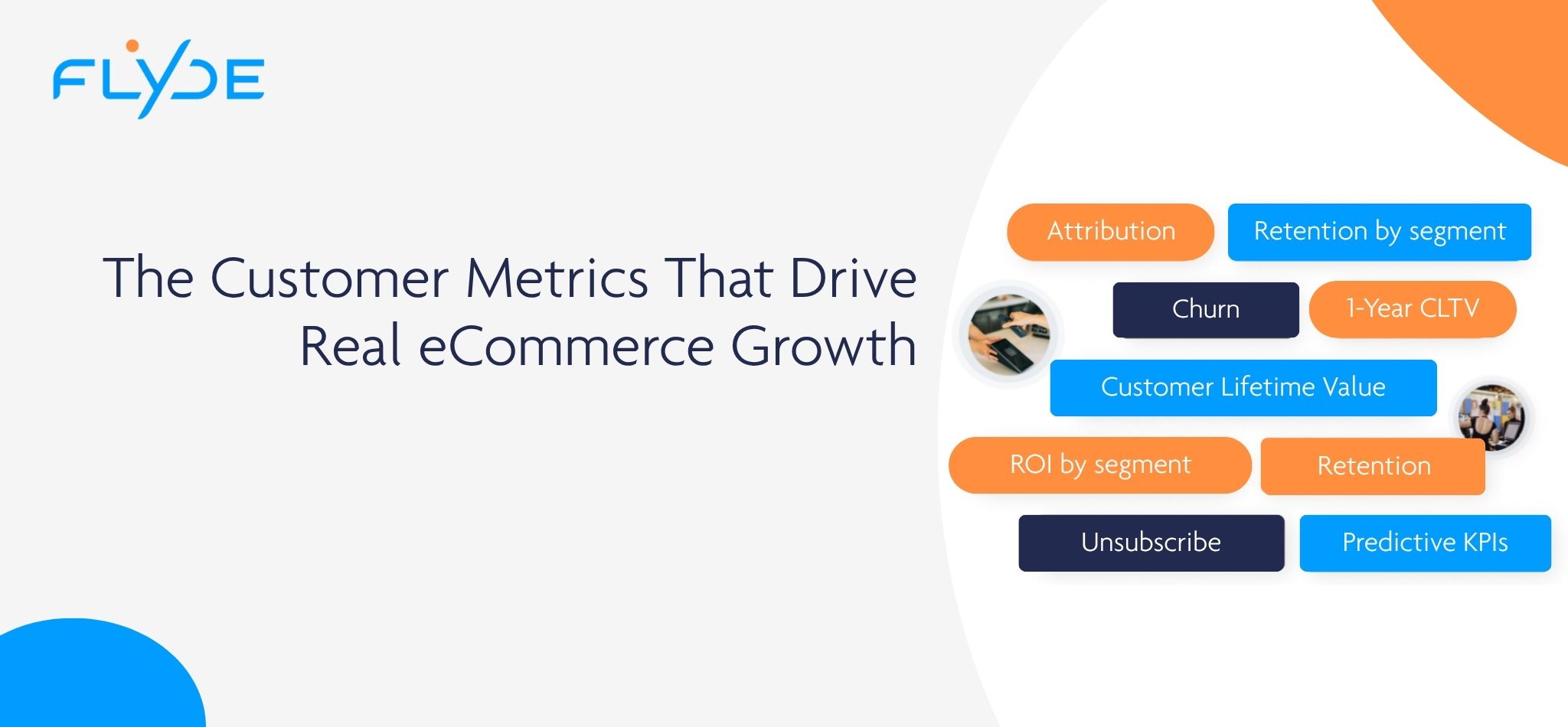
CLTV (Customer Lifetime Value)
How much revenue or margin a customer generates across their entire relationship with your brand. Without this number, it is impossible to know how much you can reasonably spend to acquire or retain a customer. As Miralda puts it directly: without CLTV, you do not know whether you are growing or destroying value.
Retention Rate by Segment
Not overall retention, but retention within your most valuable segments. A 5% improvement in retention can translate into 25% to 95% more profit, but only if you are retaining the right customers.
ROI by Customer Segment
The return on your marketing activity is not uniform across your customer base. Some segments respond well and are genuinely profitable. Others consume budget without generating real value. Without unified data, that distinction is completely invisible.
Omnichannel Attribution
Which channels and touchpoints are actually contributing to conversion and retention? The last-click model that most teams still rely on overvalues certain channels and ignores others entirely, distorting every investment decision you make.
Predictive KPIs by Customer
Knowing what has already happened is useful. Knowing what is likely to happen next is what allows you to act before a customer is lost or an opportunity closes.
WHY THESE METRICS ARE INVISIBLE WITHOUT A CDP
Every one of these metrics requires something most teams do not have: a unified view of the customer across all channels and touchpoints.
CLTV cannot be calculated accurately when online and offline purchases live in separate systems. Omnichannel attribution does not exist if digital behaviour and transactions are not connected. Predictive KPIs cannot be built without a complete history for each customer.
A Customer Data Platform (CDP) solves exactly that problem. Not because it is a reporting tool, but because it unifies the data that makes these metrics possible in the first place.
In FLYDE, the Customer 360 app gives you individualized visibility into the most relevant KPIs for each customer and predicts how those KPIs will evolve over the next twelve months. Omnichannel attribution connects every touchpoint to its real impact on conversion and retention. And predictive models let you anticipate behavior before it becomes churn or a missed opportunity.
3 QUESTIONS EVERY ECOMMERCE SHOULD BE ABLE TO ANSWER ABOUT ITS CUSTOMERS
Miralda offers a simple test. If your CDP, or whatever combination of tools you are currently using, is working properly, you should be able to answer these questions without waiting for someone to pull a report.
1. Do you know how much a customer who has been buying from you for over a year is worth on average, compared to someone who has only purchased once?
2. Which channel contributes most to retaining your highest-value customers, not to acquiring them, but to keeping them?
3. What percentage of your active customer base has a high probability of not buying again in the next ninety days?
If any of these questions draws a blank, the problem is not a lack of data. It is how that data is organized and activated. That is exactly what a well-implemented CDP resolves, and it is the starting point for moving from measuring activity to measuring business outcomes.
If you have already implemented a CDP but are not seeing real impact on your business, we’ve identified 5 patterns which stall the progress of a CDP. These patterns are common across business of different sizes and sectors. Read more here.
WANT TO GO DEEPER?
Download the ebook with Enrique Miralda’s full customer economics framework for free. Note: the ebook is currently available in Spanish only.
You’ve implemented your Customer Data Platform (CDP). The data is connected. The profiles are unified. The dashboards are live. And when someone asks what has actually changed six or twelve months later, the answer might sound like this: “We’ve connected the data sources.” “We’re unifying identities.” “We’re building segments.” “We’re setting up dashboards.”
All of that is infrastructure. And infrastructure is not why you invested in a CDP. You bought it to make better decisions, move faster and convert your most important asset, your customers, into a system that generates consistent, profitable growth.
The gap between those two realities is where many CDPs live and die.
THE REAL PROBLEM: INFRASTRUCTURE WITHOUT INTENT
Having a CDP is not a strategy. It is a starting condition.
A CDP creates the technical foundation for better decisions. But it does not make the decisions themselves. The companies that extract real, measurable value from their data, such as better retention, more efficient acquisition, and a higher margin, share one characteristic: they treat the CDP as a system to operate continuously, not a project to complete and hand over. That shift in how you think about it matters more than any feature set.
In his practical guide, CDP: Cómo convertir datos en negocio (How to Turn Data into Business), Enrique Miralda, ecommerce and digital strategy expert, puts it plainly: a CDP operated as a technology project will always end up as an expensive piece of furniture.
FIVE PATTERNS THAT EXPLAIN WHY CDPS STALL
Across different industries and company sizes, the same failure patterns appear over and over.
Use cases defined after deployment, not before.
The most expensive mistake in CDP implementations is building the data model before defining what decisions it needs to support. Teams connect sources, celebrate the integration, and then discover there is no clear answer to the question: what do we do with this now? If you cannot name three decisions you will make differently once your CDP is live, you are not ready to build it.
Insights that stop at the dashboard.
Segments get built. Behavioral data gets analyzed. Reports get shared in quarterly reviews. And then nothing changes in how customers are actually reached. Data without activation is storage. The value of a CDP is not what it knows, but what it triggers.
Miralda frames this as a four-step cycle: data, decisions, actions, and measurement. If your CDP is not running that cycle continuously, it is not just underused. It is a mere decoration.
Operational dependency on technical teams.
When every new segment requires a ticket and every activation requires IT involvement, the CDP stops being a competitive asset and becomes a bottleneck. The people who understand the customer need to be able to act on the data directly. When they cannot, adoption quietly dies.
Measuring activity instead of impact.
Opens, clicks and send volume are not business outcomes. They are proxies that feel safe because they are easy to report. Without some form of incremental measurement (understanding what changed because of an action, compared to what would have happened anyway), it is impossible to know whether a CDP is generating value or just generating noise.
Miralda labels this as the difference between saying “we did things” and “we generated revenue.”
No ownership, no system.
A CDP touches marketing, data, technology and in many cases, operations. Because it belongs to everyone, it frequently ends up owned by no one. Without an accountable owner, a clear operating process, and a regular cadence for reviewing and improving use cases, your CDP will drift toward irrelevance. And it’s not because the technology failed, but because no one kept driving it.
Miralda covers this in detail in his ebook, including a weekly operating model and a clear accountability structure.
SEVEN QUESTIONS TO ASSESS THE UTILITY OF YOUR CDP
These are not questions for a vendor evaluation. They are for an honest internal conversation.
1. Can you name three decisions you make better today because of your CDP?
2. Do you have at least one active use case with a measured, incremental business result?
3. Can your marketing team activate new segments without waiting on IT?
4. Is there one person who has real authority, clear accountability, and ownership of CDP outcomes?
5. Do you know which customers you should not be contacting right now?
6. Are you measuring incremental impact or just campaign activity?
7. Is your CDP part of a defined operating process or is it a tool people log into occasionally?
If several of these questions produce hesitation, the underlying issue is almost always the same: not the platform, but the absence of a framework for turning data into decisions and action on a repeatable basis.
GOING DEEPER: A PRACTITIONER’S GUIDE TO MAKING CDPS WORK
If you recognise any of these patterns, you already know where to find a structured path forward.
Enrique Miralda’s guide is available to download for free. Please note it is currently only available in Spanish.
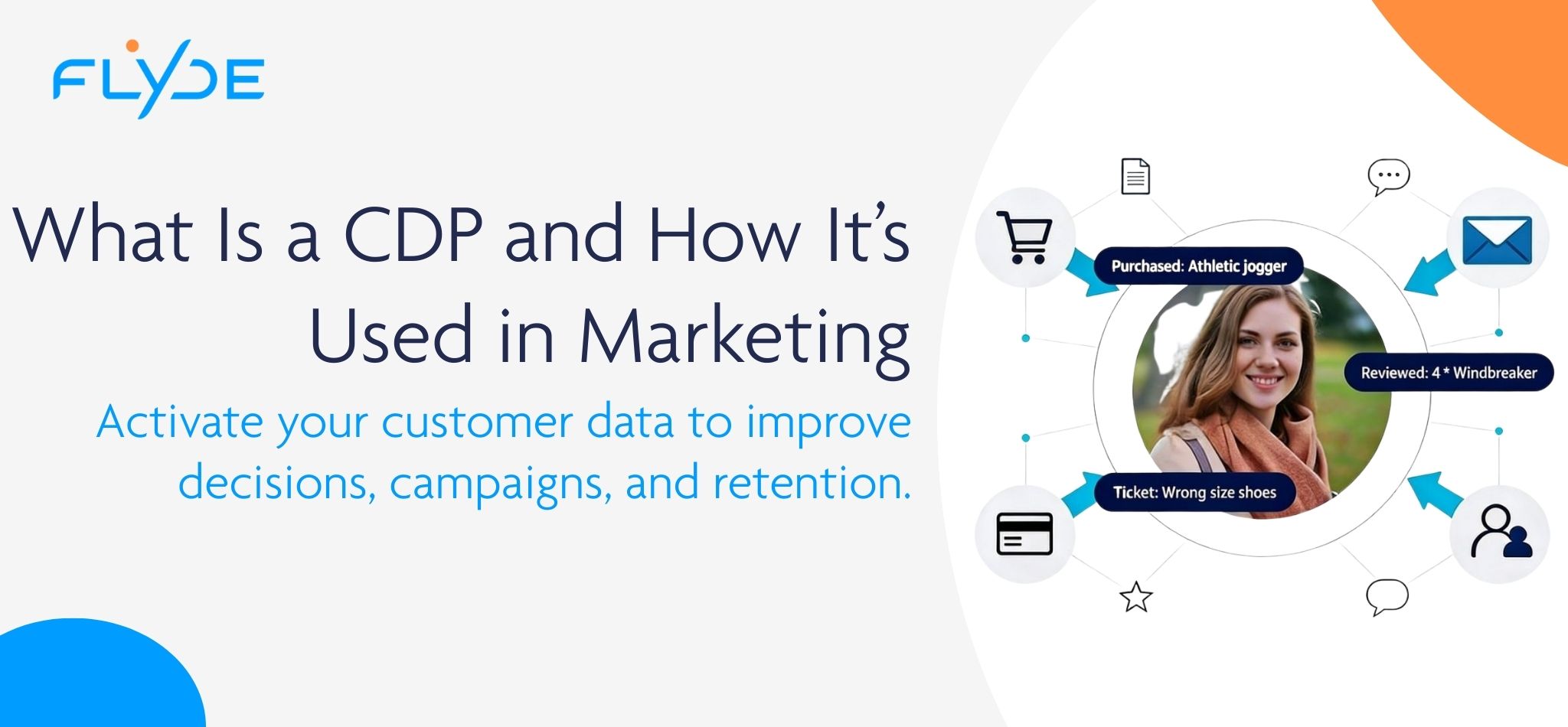
Most companies store customer data across multiple tools. The CRM records sales interactions. The email platform stores campaign history. The ecommerce system tracks orders. The customer support tool logs tickets. Each system has its own version of the customer. And none of them talk to each other.
The result is predictable: decisions based on partial information, marketing campaigns that ignore what customer support already knows, and customers receiving irrelevant messages because no one has a complete picture of who they are. The CDP exists to solve exactly that problem.
Understanding what a CDP is is only the first step. The real challenge is not just unifying data, but using it consistently to improve marketing decisions, retention, and campaign efficiency. In this series, we explore how to do that in practice.
WHAT IS A CUSTOMER DATA PLATFORM (CDP)?
A CDP, or Customer Data Platform, is software that collects customer data from multiple sources and unifies it into a single profile for each customer, primarily based on first-party data.
Unlike other data tools, a CDP is designed specifically to manage first-party data, meaning the data generated through your direct relationship with the customer. In simple terms, a CDP unifies data from all of your sources in order to reveal who each customer is, what value they represent for your business, and how likely they are to buy or churn.
The value doesn’t come from having this data, but from being able to use it operationally in marketing and business decisions.
HOW A CDP IS USED IN MARKETING?
Advanced segmentation
Rather than segmenting by basic demographic variables such as age, location or gender, a CDP lets you build audiences based on real behaviour: customers who have purchased more than twice in the last 60 days, customers showing high churn propensity based on usage patterns, high-value customers who haven’t engaged in weeks. These segments update dynamically, without manual exports.
Personalization at scale
With a unified profile per customer, messages can be adapted to each person’s real context: their history, their preferred channel, their stage in the customer lifecycle. Personalization stops being a one-off project and becomes part of standard operations.
Data activation in campaigns
The value of unified data comes from being able to use it where decisions actually happen. A bottleneck often forms between data and action: the marketing team identifies a segment they want to activate, requests it from IT, IT prepares it, and by the time the audience is ready, the context has changed. For companies with high customer turnover or short purchase cycles, this delay is especially costly.
A CDP removes that intermediary. Segments are built directly on unified data and sync automatically with execution channels. The email platform launches the campaign with the right audience, the paid media manager excludes customers who already purchased, the customer service system shows the customer’s full context before the agent picks up the phone. Everything runs on the same profile and updates every time the customer does something new.
Precise attribution
By unifying customer behavior across all touchpoints, a CDP helps you understand which channels and campaigns actually contribute to conversion—and which ones simply appear along the journey without influencing the decision.
HOW DOES A CDP WORK?
A CDP operates across three layers that work continuously.
Data ingestion
The CDP ingests data from all relevant sources: website, app, ecommerce platform, CRM, email tools, customer service system, point of sale where applicable. This ingestion can happen in real time or in batches depending on the need, and the CDP can process both structured data and behavioural events.
Profile unification
Once data is received, the CDP consolidates it into a single profile per person. This means resolving the customer’s identity across different identifiers such as email, phone number, user ID and navigation fingerprint, to ensure that interactions from the same person across different channels are attributed correctly and don’t create duplicate or contradictory profiles.
Data activation
The unified profile is made available to other systems. The marketing team can build segments and push them to their paid media platform. The email tool can personalise content based on the customer’s history. The customer service agent can see full context before responding.
CDP vs. CRM vs. DMP: WHAT’S THE DIFFERENCE?
It’s common to confuse these three technologies because they all work with customer data, but they serve different purposes, have different scopes, and are used by different teams.
What is a CRM?
A CRM (Customer Relationship Management) is a platform designed to manage relationships with customers and prospects. It centralizes key information such as contacts, sales interactions, and deal stages, and helps sales teams organize and track their pipeline.
What is a DMP?
A DMP (Data Management Platform) is a tool focused on audience management for advertising. It collects and combines data, primarily from third-party sources, to create highly specific segments that can be activated in marketing and digital media campaigns.
Summary of the three tools:
.flyde-compare{ font-family:-apple-system,BlinkMacSystemFont,"Segoe UI",Roboto,Arial,sans-serif; margin:40px 0; } .flyde-compare table{ width:100%; border-collapse:separate; border-spacing:0; border:1px solid #e6e8ec; border-radius:14px; overflow:hidden; box-shadow:0 6px 18px rgba(0,0,0,0.05); } .flyde-compare th{ background:#ff8e3e; color:#fff; padding:18px; font-size:13px; text-transform:uppercase; letter-spacing:.05em; text-align:center; } .flyde-compare th:first-child{ text-align:left; } .flyde-compare td{ padding:18px; border-top:1px solid #eef0f3; font-size:15px; color:#334155; text-align:center; } .flyde-compare td:first-child{ text-align:left; font-weight:600; background:#f8fafc; color:#0f172a; } .check{ color:#16a34a; font-weight:700; font-size:18px; } .cross{ color:#ef4444; font-weight:700; font-size:18px; } .partial{ color:#f59e0b; font-weight:700; } @media(max-width:768px){ .flyde-compare table{ display:block; overflow-x:auto; } }
| Feature | CDP | CRM | DMP |
|---|---|---|---|
| Unified customer profile | ✓ | Partial | ✕ |
| Behavioral data | ✓ | Limited | ✓ |
| Transactional data | ✓ | ✓ | ✕ |
| Anonymous data | ✓ | ✕ | ✓ |
| Audience activation | ✓ | Limited | ✓ |
| Main use case | Marketing and personalization | Sales and customer management | Programmatic advertising |
| Data updates | Real-time | Manual / partial | Campaign-based |
The relationship between CDP and CRM is particularly worth understanding: they are not competitors. The CRM manages the commercial process and the relationship with known customers. The CDP provides the layer of behaviour and value that makes that process more intelligent. In many companies, the CDP feeds the CRM with context it couldn't build on its own.
CDP USE CASES
Personalizing retention campaigns
A fashion retailer with both ecommerce and physical stores uses its CDP to identify customers who are starting to disengage: fewer purchases over the past 90 days, lower interaction with campaigns, and no recent visits to the website or stores.
Before losing them, the retailer activates a targeted campaign for this segment. The message, channel, and incentive are tailored to each customer’s value, with product recommendations based on past purchases, early access to new collections, or a personalized offer to drive the next purchase.
Optimization of paid media campaigns: audience exclusion
An office supply retailer with physical stores and an ecommerce channel runs paid media acquisition campaigns. The problem: their advertising platforms only see what happens in the digital channel. A customer who bought in-store last week still appears as a prospect in the ads system and keeps receiving acquisition messages. Not only do the messages annoy the customer, but they also represent wasted spend for the company.
With a CDP that unifies data from physical stores and digital channels into a single profile, that customer is removed from acquisition audiences as soon as their purchase completes, regardless of where it happened. The exclusion is automatic and updates in real time. The budget that was being spent trying to convert someone who already converted gets redirected towards real prospects or towards loyalty campaigns for that same customer.
Customer behavior analysis: understand what makes a client stay
A gym chain notices that churn is concentrated in the first 60 days. The problem is that all new members look identical at sign-up, with the same membership fee and the same contract, but some disappear within weeks while others stay for years.
Using the CDP, the chain crosses first-30-day behaviour with long-term retention and finds the pattern: members who attend at least three times in their first week and take part in at least one group class before day 15 have a significantly higher 12-month retention rate than the rest. The pattern in the data is clear.
Armed with that insight, they redesign onboarding: new members receive specific communications pushing them towards those two behaviours in their first week. Not discounts or generic welcome messages, but actions designed to guide them towards the behavior that predicts long-term retention.
WHY CDPS MATTER FOR MODERN BUSINESSES
Omnichannel marketing
Customers interact with brands across multiple touchpoints, such as web, app, physical store, social media and customer service, and expect a consistent experience across all of them. Without a layer that unifies those interactions, consistency is impossible: each channel operates on its own incomplete version of the customer, unaware of what happened elsewhere.
Data-driven decisions
As marketing teams take on greater accountability for business outcomes such as retention, margin, and cost to serve, they need data that goes beyond campaign metrics. A CDP provides the foundation to measure real impact, not just activity.
A CDP helps teams move from fragmented data to more consistent and informed decisions.
Campaign efficiency
The ability to segment precisely, exclude people who shouldn't receive a message, and personalize based on real context reduces advertising waste and improves conversion without necessarily increasing budget.
ACTIVATE YOUR DATA WITH FLYDE
Having a CDP is the first step. Real value appears when data becomes concrete actions with measurable business impact.
FLYDE combines CDP technology with strategic and operational support to help companies see results in weeks, not months. The focus is on identifying the highest-return use cases from the start, executing them with rigor, and measuring impact incrementally, so that every investment decision is backed by real data, not assumptions.
If you want to explore how a CDP can apply to your specific context, Enrique Miralda's ebook, CDP: How to Turn Data into Business, on customer data platforms is a good starting point: it covers everything from the fundamentals to a 90-day roadmap with real results.
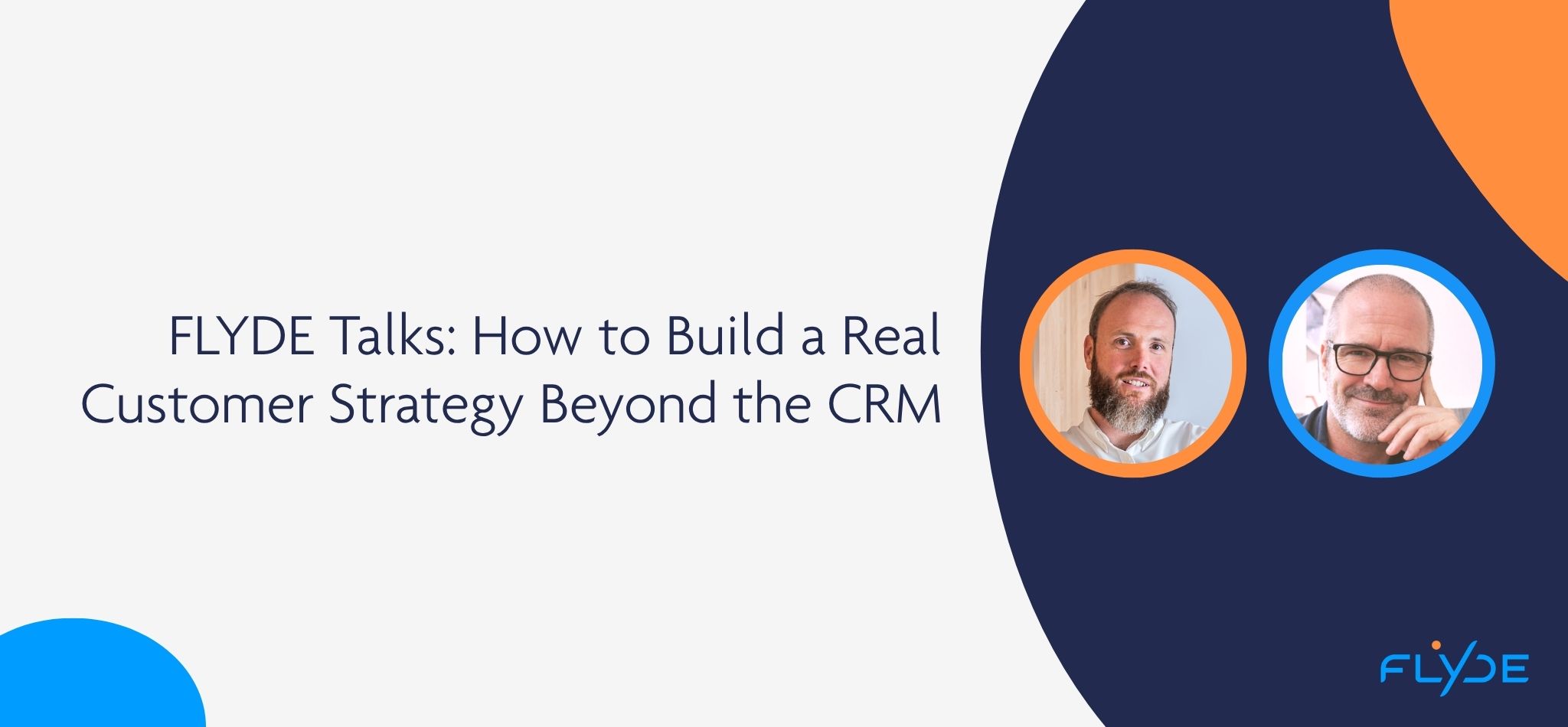
In the fifth episode of FLYDE Talks, Paco Herranz, founder and CEO of FLYDE, sat down with Enrique Miralda, an expert in digital strategy and ecommerce with over 20 years of experience. More than an interview, it was a dialogue between two professionals who work day-to-day with companies at very different stages of digital maturity. The conversation focused on why most companies don’t have a real customer strategy and what it takes to build one.
WHO OWNS THE CUSTOMER IN YOUR COMPANY?
If you ask most organizations who is responsible for the customer, the answer is usually silence. And according to Enrique Miralda, that silence is the clearest sign that no real customer strategy exists.
Customers are the primary asset in any business. Yet what typically happens is that marketing has one view, the CRM team has another, and the customer experience department limits itself to handling complaints. Each department manages its own version of the customer and those versions rarely match.
The result is that the same customer can receive contradictory messages from three different departments on the same day, without anyone realizing it. Paco reinforced this from his direct experience with FLYDE clients: the absence of a clear owner isn’t just an organizational symptom; it’s the most telling sign that no real customer strategy exists.
THE IMBALANCE BETWEEN ACQUISITION AND RETENTION
Enrique noted that around 70% of marketing investment goes towards acquiring new customers, with barely 30% directed at retention. This happens despite the fact that retaining a customer is five times more profitable than acquiring a new one.
And there’s an even more critical insight: unless a company has a gross margin above 45-50% or a very high average order value, its business will not be profitable until the second purchase happens. A new customer is not profitable the day they arrive. They become profitable when they come back.
Paco added another angle he sees repeatedly in FLYDE’s own sales process: often there are several departments talking to the customer through different channels, with no coordination, and none of them actually listening. The problem isn’t too much communication but rather the lack of a unified customer view to back it up.
CRM VS. CDP: THEY ARE NOT THE SAME THING
One of the most common misconceptions is that a CRM is enough to manage customer strategy. Enrique is clear: the CRM has a concrete and valuable function, but it has important limitations.
A CRM provides a snapshot of current customers, but it doesn’t work with anonymous users, has no real predictive capability, and doesn’t unify the customer view across all channels. A customer who buys in a physical store, on the website, and through an app can appear as three different people.
A CDP (Customer Data Platform) is designed to solve exactly that: unifying all customer information into a single profile, diagnosing behaviors, predicting future actions and prescribing the best strategies for each segment.
EVERY BUSINESS IS A FINANCIAL BUSINESS
Enrique is particularly critical of the lack of financial perspective in marketing and ecommerce teams. Measuring profitability through gross margin is a common mistake. What matters is the contribution margin, which deducts all real costs: payment commissions, shipping, packaging, returns and marketing campaigns.
It is perfectly possible to have a positive ROAS and still be losing money. Everyone making decisions about customers should be able to answer this question: at what point does this customer start to be profitable for my business?
THE CDP AS AN INVESTMENT, NOT A COST
For Enrique, there is no room for doubt: he knows of no more profitable investment in ecommerce than a well-implemented CDP. With the right agility, it is common to see a return that covers the platform cost within 60 to 90 days. In some cases, a single use case has generated enough margin to pay for the tool for two years.
The key is speed of implementation. Tools like FLYDE are designed so that business teams can operate with maximum independence from IT, activating use cases in weeks, not months.
CONCLUSIONS
Companies that build a real customer strategy share five characteristics:
- They have defined who owns the customer within the organization.
- They balance investment between acquisition and retention.
- They understand the difference between CRM and CDP, and use each tool for what it was designed for.
- They measure in terms of contribution margin, not gross margin or ROAS in isolation.
- They start with concrete use cases that demonstrate fast ROI, and scale from there.
The question every company should ask is not what new tool they need, but who is responsible for ensuring their customer is treated with excellence at every touchpoint.
DOWNLOAD ENRIQUE’S EBOOK
If this conversation has raised questions about how to implement a CDP, how to measure its return, or how to structure the use cases that generate the most value, Enrique Miralda has just published the book that answers exactly that.
CDP – Customer Data Platform: How to Convert Data into Business is a practical guide covering everything from the minimum technical requirements you should demand, to a 90-day roadmap with real use cases, contribution margin metrics and step-by-step numerical examples. It also includes chapters on AI applied to CDP, weekly operating models and a comparative guide to the leading platforms on the market.
This is not a book about concepts. It is a manual for going from “we have a CDP” to “the CDP is generating value.”
The ebook is currently available in Spanish.

Acquiring a new customer costs between five and twenty-five times more than retaining an existing one. And yet, most retail companies continue to direct the majority of their marketing budget toward acquisition.
And yet, most retail companies continue to direct the majority of their marketing budget toward acquisition, even though 65% of their revenue comes from just 8% of their most loyal customers.
The explanation seems obvious. Without acquisition, there is no business.
But framing client strategy as a choice between acquisition and retention is an oversimplification. The real problem is that many companies do not have a precise understanding of when a customer becomes profitable. And without that answer, any debate about budget allocation is, at best, an educated guess.
Striking the right balance between acquisition and retention depends on three factors that vary significantly across businesses: product margin, purchase type and the point in the customer cycle at which real value is generated.
For a premium furniture or appliance retailer, the cost of acquisition may be recovered on the first order. The customer arrives with the decision practically made, clear purchase intent and a high ticket value. In that case, the strategic priority is not necessarily to accelerate a second purchase, but to convert a good experience into a recommendation.
For a fashion brand investing in paid social and offering welcome discounts, the first purchase is likely not to be profitable. Profitability typically arrives with the second purchase, when the customer buys without an incentive.
For a jewelry brand or luxury label, the return can take years to materialize, sometimes not until the third or fourth transaction. Acquisition costs are high and purchase frequency very low. The key to profitability lies in the long-term client relationship.
Without understanding that profitability threshold, it is impossible to decide how much to invest in acquisition, how much in retention, and which levers to activate at each stage of the customer cycle. Yet many companies still cannot answer that question clearly.
WHY FINDING THE RIGHT BALANCE IS SO DIFFICULT
Measurement and attribution present significant challenges.
Customers typically interact with a brand across multiple platforms before making their first purchase. A social media ad, a recommendation from a friend, an organic website visit or an email can all be part of the same decision-making process.
The complexity increases further after the first purchase.
Imagine a customer who is satisfied with their order, joins the loyalty program, receives an email three weeks later, and returns to buy. What brought them back? The product? The loyalty rewards program? The email? A combination of all three?
The effects accumulate over time and rarely appear cleanly in any dashboard. Understanding them requires a longer view of the customer cycle and a different attribution logic.
This is why many marketing decisions are still made based on partial or short-term metrics. And when metrics are incomplete, investment tends to concentrate on what is most visible and easiest to measure: acquisition.
THE REAL COST OF IGNORING RETENTION
The well-known finding that acquiring a new customer costs between five and twenty-five times more than retaining an existing one appears consistently throughout the marketing literature and has been widely cited by Harvard Business Review.
A similarly striking finding comes from relationship marketing research. It is estimated that a 5% increase in customer retention can increase profits by between 25% and 95%, according to research by Frederick Reichheld of Bainand Company.
The potential impact is too significant to treat retention as a secondary priority.
But activating that lever correctly requires more than increasing the volume of CRM campaigns. It requires understanding precisely who your customers are, what value they generate, and where they are in the cycle.
And that is where many organizations run into another obstacle.
HAVING DATA IS NOT THE SAME AS HAVING CUSTOMER INTELLIGENCE
Today’s retail companies accumulate large amounts of information: purchase histories, web behavior, loyalty data, customer service interactions and email opens.
But having data does not mean truly knowing the customer.
In many organizations, information is fragmented across multiple systems. Purchase history lives in Shopify. Loyalty promotions in another platform. Browsing behavior in Google Analytics. Support interactions in Zendesk. Email campaigns in Klaviyo.
Each system knows something about the customer, but none of them actually knows the customer.
Without a layer that unifies those signals, it is impossible to have a clear picture of who that customer is, what interests them, and where they are in the cycle.
That is why the first step toward a solid client strategy is usually not segmentation or artificial intelligence. It is data architecture.
A Customer Data Platform (CDP) makes it possible to unify those sources into a single, actionable customer profile. It is not just a marketing tool. It is the foundation that allows any acquisition or retention strategy to operate with real business logic.
HOW METRICS ARE CONVERTED INTO BUSINESS DECISIONS
When customer data is centralized, segmentation can begin to answer questions that are relevant to the business. Which customers generate the most value? Who is at risk of churning? And who has the greatest growth potential?
Predictive models can identify early churn signals, such as drops in purchase frequency, absence of interaction or a declining average order value.
What distinguishes companies that grow sustainably is their ability to convert operational metrics into business decisions. Many teams still measure email open rates, click-through rates and volume of communications sent. These are useful metrics, but they rarely answer the questions that actually matter.
How many at-risk customers were recovered?
How many moved from a first to a second purchase as a result of a specific initiative?
How much did the lifetime value of customers acquired last quarter increase?
When analysis focuses on the complete customer cycle, the debate between acquisition and retention begins to lose its relevance. Both become levers within a single strategy.
ROADMAP FOR BUILDING A CUSTOMER STRATEGY
1. Identify when your customer becomes profitable. Do not assume it is the same for every business. Knowing the threshold precisely is the prerequisite for everything else.
A premium furniture or appliance retailer may recover acquisition costs from the first order. A fashion brand running paid social with a welcome discount rarely sees profitability on the first transaction: the threshold comes with the second purchase, the one made without an incentive. A jewelry or luxury brand may not see a return until the third or fourth transaction, sometimes years later. When acquisition costs are structurally high and purchase frequency very low, the bet is not transactional but rather relational.
2. Revisit the segmentation logic based on the business model.
For high-frequency businesses such as online supermarket or pharmacy, the priority is usually detecting early churn signals: small drops in frequency are warning signs that predictive models can identify before the customer is lost. For low-frequency businesses such as furniture or electronics, the key is to identify customers with the greatest potential for recommendation or to upsell at the right moment. If segmentation does not make this distinction, it is not serving the business.
3. Design initiatives for the critical moment in each business’s customer cycle.
For most ecommerce businesses, that moment is the transition between the first and second purchase, the most decisive and most neglected stretch. For high-frequency businesses, it is early churn prevention, where predictive intelligence adds the most value by acting on risk signals weeks in advance. For high-ticket businesses, it is the post-sale experience and the long-term relationship. The question is not “what campaign do we launch?” but “what does this segment need, in this type of business, at this specific moment?”
4. Define who owns the client strategy, with real authority over budget and KPIs.
In many organizations the customer belongs to several teams but to none in particular. Marketing, CRM and ecommerce each work on parts of the cycle, but no one has a complete view of the customer or direct responsibility for their profitability. In a business where the customer becomes profitable on the second purchase, someone has to be accountable for ensuring that second purchase happens.
5. Incorporate advocacy as a growth engine, especially in businesses where paid media shows diminishing returns.
A satisfied customer who recommends the brand can generate new customers at near-zero acquisition cost and with a retention rate higher than any paid channel. For high-ticket, low-frequency businesses, advocacy is not an add-on: it is the most efficient path to growth. For high-frequency businesses, it is the lever that closes the loop between retention and acquisition. In both cases, it is the most systematically overlooked element in marketing plans.
FLYDE TALKS 5
These questions will be at the center of FLYDE Talks 5, on 24 March at 6pm CET via LinkedIn Live, where FLYDE CEO and Founder Paco Herranz and digital strategy expert Enrique Miralda will discuss how to build a true client strategy in retail.
You can register for the event here. Kindly note that the session will be held in Spanish.
We’ve launched Brain, an AI copilot that brings natural language capabilities to the FLYDE Customer Data Platform. You can now ask questions and get answers directly from your data without needing SQL knowledge or waiting on technical teams.
Ask Brain your questions in natural language. Get actionable answers based on your real business data.
With Brain, you can create datasets, build audiences, analyze results, generate reports, and make strategic decisions powered by predictive intelligence, all by writing in natural, conversational language. Brain also helps you ask better questions, deepen analysis with suggested follow-ups, prepare presentations instantly, and collaborate seamlessly across teams.
BRAIN IN CORE: GENERATE DATASETS WITHOUT WRITING SQL
Core is FLYDE’s app for data storage, conversion, and transformation. It is where you connect data from different sources, consolidate everything into one place, and build the datasets that power your marketing decisions. Historically, creating datasets has required technical knowledge, writing SQL queries, or waiting for your IT team.
Brain changes that entirely.
When creating a dataset in Core, simply describe what you need in plain language; fore xample, “I want sales by user and loyalty points.” Brain interprets your request and automatically generates the SQL query needed to build it.
This enables marketing and business teams to work independently, dramatically shrinks turnaround times, and accelerates data exploration. SQL generation democratizes advanced analytics, allowing more team members to work directly with data.
BRAIN IN MARKET: CREATE AUDIENCIES AND ANALYZE BEHAVIOR
Market is FLYDE’s audience activation and management application. It’s where you build customer segments that fuel your campaigns, activate them across channels, and understand their behavior.
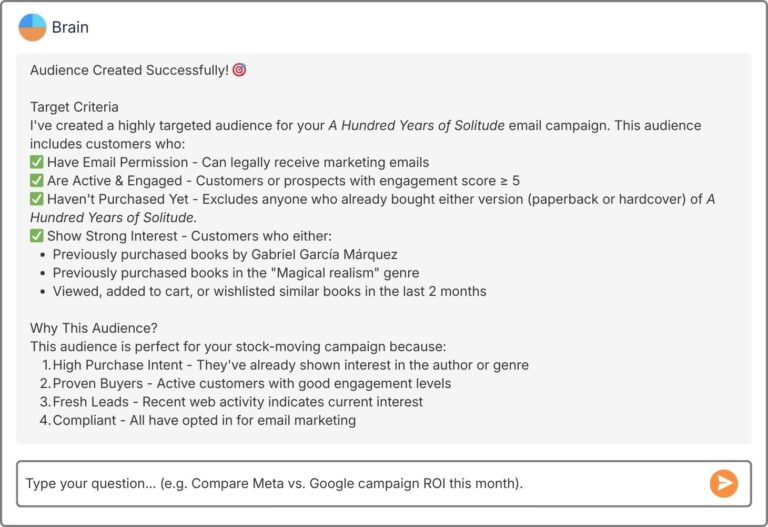
With Brain in Market, you can create new audiences using natural language instead of manually applying filters. Describe what you need and Brain translates it into the appropriate filter logic.
Example: A bookstore has overstock of the novel, A Hundred Years of Solitude, by Gabriel García Márquez and wants to run a targeted promotional campaign via email. Rather than manually configuring filters, you can tell Brain: “Create an audience of customers who are likely to buy A Hundred Years of Solitude and opted in to promotional emails.” Brain generates the audience in seconds, and explains the logic to you, every step of the way.
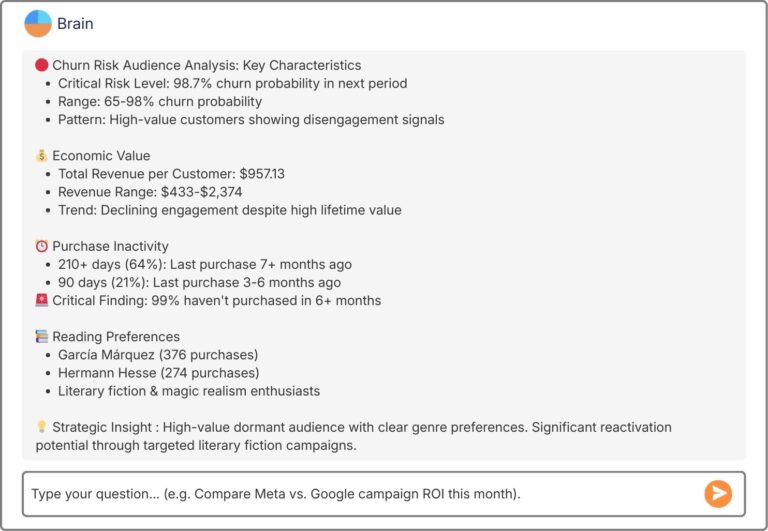
Brain can also analyze your audiences and propose strategic opportunities for action. You can ask follow-up questions directly within reports to understand behavior and surface additional insights.
Example: You have an audience of high-churn-risk customers. You say to Brain: “Analyze the main characteristics of my clients who show strong signs of churn and help me figure out how to retain them.” Brain analyzes the data and identifies key behaviors and characteristics as well as recommended next steps.
MARKET TALKS: ADVANCED ANALYTICS CONVERSATIONS
Market Talks is FLYDE’s advanced analytics application. While Market focuses on audience creation and activation, Market Talks is where you explore the metrics most relevant to your business, such as sales, channel performance, segment behavior, and revenue trends.
If you say to Brain, “Give me an in-depth analysis of purchases by channel for the last year,” Brain will deliver detailed insights, strategic interpretation, downloadable charts, improvement recommendations, and suggested A/B tests based on findings.
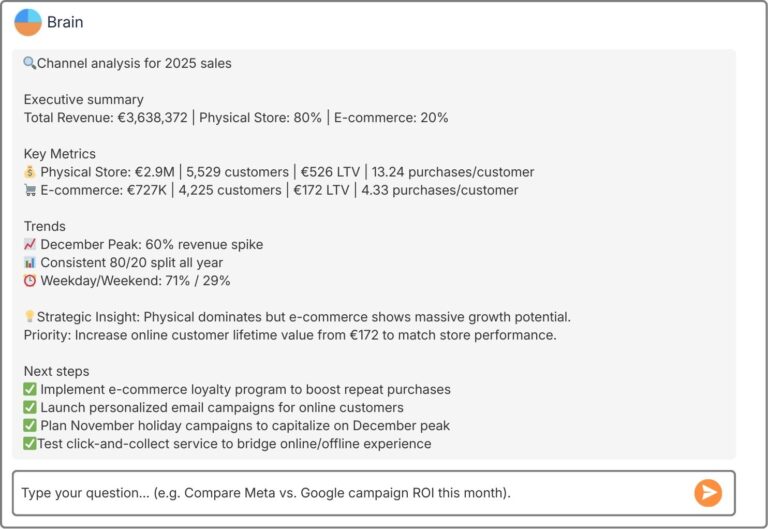
Need to present findings to leadership? Ask Brain to generate a downloadable PowerPoint presentation with key insights.
You can also save your conversations with Brain using custom names, organize them in folders, and share with teammates. Analysis becomes a collaborative asset.
BRAIN GUIDES YOU TO DEEPER ANALYSIS
One of Brain’s most powerful features is offering automatic suggestions for follow-up questions. After you complete an analysis, Brain proposes new paths of exploration based on patterns in your data.
After analyzing sales by channel, Brain might suggest: “Want to compare margin by channel? See how this compares to last year? Understand which segments are driving most of your growth?”
This system combats shallow analysis and interpretation bias. Instead of stopping at the first answer, Brain guides you deeper, acting as a thinking partner that drives a more mature analytical culture.
The impact on your business is direct: better-informed decisions, discovery of hidden opportunities, early detection of risks, and stronger alignment between data and strategy.
THE CONVERSATIONAL APPROACH
Brain works consistently across Core, Market, and Market Talks. You describe your data needs in Core. You create and analyze audiences in Market. You run advanced analytics in Market Talks. The same conversational approach can be used everywhere.
This reduces friction when moving between analysis and action. You stay in a natural language workflow instead of switching between interfaces, languages, and tools.
GETTING STARTED WITH BRAIN
Brain is live across Core, Market, and Market Talks. Start using it on your next dataset creation, audience build, or analysis.
Brain can also integrate directly with your existing ecosystem to provide an intelligent layer of analysis with a conversational approach over business data without changing your data infrastructure. Contact us if you would like to see a demo of Brain in action.

In the fourth episode of FLYDE Talks, Paco Herranz, founder and CEO of FLYDE, spoke with Álvaro Pariente, data and enterprise technology expert and founder and CEO of BEOC9, to analyze the key factors that will determine business success this year. The conversation explored crucial topics such as how to organize data, the role of CDPs (Customer Data Platforms), and why many companies are not seeing real results from artificial intelligence.
THE CRITICAL TRIANLGE: BUSINESS, DATA AND IT
Álvaro began by highlighting a structural issue affecting many organizations. For years, companies have been digitizing processes and collecting data across multiple systems. However, this transformation created a problematic divide between three departments that should be working together:
- IT: decides on architecture and systems
- Business: defines the “what” and how to impact the customer
- Data: often scattered between IT and business, with no clear owner
The result is predictable: data silos, lack of coordination, and multiple departments engaging the same customers as if they were entirely different companies.
The solution is not technological but rather organizational. Before investing in tools or implementing AI, companies need to align these three pillars internally and give them equal importance. Only then can they extract real value from their data.
THE REAL PROBLEM: ATTRIBUTION AND FRAGMENTATION
A perfect example of this lack of organization is conversion attribution. When multiple departments interact with a customer through different channels (paid media, email, etc.), each one claims the conversion as its own.
The problem becomes even more troublesome in fast-growing companies that are investing aggressively in acquisition, because proving the return on each channel is critical.
THE EVOLUTION OF CDPs
Álvaro explained how the market has evolved from MDM systems (Master Data Management) to the new generation of CDPs. MDM systems required long projects, complex integrations, and the creation of a centralized “Golden Record” that often became invasive for existing systems.
Modern CDPs offer a different approach:
- Less intrusive: they connect to existing systems without disrupting operations.
- Continuous data collection: they unify data from multiple sources in real time.
- Identity resolution: they build a single customer view without requiring a centralized record.
- Fast activation: they allow immediate use of that information in the right channels.
- Compatibility with your tools: they do not require a single-vendor infrastructure and can connect with Adobe, Salesforce, Braze, or other tools.
Paco emphasized the importance of this point: no single vendor can cover every use case a business needs.
THE UNCOMFORTABLE TRUTH ABOUT AI
This was the most critical point of the conversation. Álvaro was direct:
“Without data organization and data scale, AI, in my view, will not take you anywhere.”
The problem is not the AI model. The problem is the data.
WHY MANY COMPANIES ARE NOT SEEING RESULTS WITH AI
ChatGPT works because it has access to a massive encyclopedia of information on the internet. But when a company wants to apply AI to its business, it is not querying the internet. It is querying its own internal data.
And that is where things become complicated:
- If your data is not organized
- If your prompt is poorly structured
- If your systems lack coherent information
- If your data is fragmented into silos
The result will not be what you are hoping for, no matter how much money has been invested in sophisticated technology.
The companies seeing real value from AI all share one thing in common: they organized their data first (customer information, internal processes, organizational knowledge), and only then applied technology. Not the other way around.
AN EXAMPLE: SENTIMENT ANALYSIS
Paco shared a concrete case: a company with millions of customer interactions whose only measure of satisfaction was sending Net Promoter Score (NPS) surveys, which most people do not respond to.
The solution is clear if the data is organized: run those conversations through AI-powered sentiment analysis. The company already has all the information needed to determine whether a customer is happy, frustrated, or about to leave a negative review.
No new data is required. The data is already there. The only missing piece is applying the right technology on top of a well-organized data foundation.
SECURITY AND GOVERNANCE: NON-NEGOTIABLES
A critical point was emphasized: you cannot send private company data into a public LLM without proper safeguards. Doing so would expose employee and customer data.
The solution is to use models (OpenAI, Anthropic, Google) within a secure architecture that includes:
- Data governance policies
- Access control
- GDPR compliance in Europe
- Clear management of what data is served, what is exposed, and what is received
IMPLEMENTATION STRATEGY
The conversation also addressed how implementation timelines have changed. Álvaro was clear: 18-month projects are a thing of the past.
The strategy that works today is:
- Focus on one single use case (not seven)
- Implementation in a maximum of 2 to 3 months
- Measurable impact on a specific KPI (churn, lifetime value, RFM)
- Iterate and expand once value is proven
This approach has clear advantages:
- Reduces time and costs
- Makes ROI traceable
- Drives adoption and change within teams
- Results improve exponentially with each new use case
As Álvaro said: “If consulting doesn’t deliver value, and value is tied to KPIs, then we shouldn’t be there.”
THE GARTNER MAGIC QUADRANT
The conversation closed with an analysis of the recent Gartner Magic Quadrant for CDPs (2026), the third report since the category was created in 2024.
Key trends identified include:
- Expansion beyond marketing: CDPs are no longer only for segmentation and campaigns. They are increasingly being used for B2B use cases, customer service, sales, and operations.
- Composability as the standard: the ability to integrate with multiple systems without requiring a full single-vendor suite is becoming a baseline requirement.
- AI and natural language access: platforms that allow users to query data using natural language are enabling business users (non-technical teams) to extract insights without needing SQL.
- The importance of connectors: competition is being defined by the speed and quality of integrations. It is no longer acceptable for a connector to take three months when it should be as simple as “pushing a button.”
CONCLUSIONS: A ROADMAP FOR COMPANIES THAT WILL WIN IN 2026
The main lesson from FLYDE Talks Episode 4 is clear: the companies that integrate data, technology, and business strategy will be the true winners in 2026.
It is not about having the most advanced AI model. It is about:
- Organizing your internal structure so data, IT, and business teams work together
- Implementing a CDP that unifies information without being invasive
- Applying AI to your own data with proper governance and security
- Starting with specific use cases that prove ROI quickly
- Scaling iteratively
The question every company should ask is not “What new tool do I need?” but “How do I make my current investment deliver more value?”
HOW FLYDE CAN HELP
Is your company’s data ready for AI? At FLYDE, we will continue driving conversations that help organizations understand this new landscape and take advantage of AI within a secure, results-driven framework. Contact us to explore how you can leverage new technologies within your company.

Artificial intelligence promises efficiency, automation, better decisions and competitive advantages. Yet in practice, many organizations keep asking the same question: If we have so much data, why is it still so hard to generate real business impact?
The challenge isn’t AI itself; it’s how you leverage it. Before talking about predictive modelling, algorithms, or AI copilots, it’s essential to take a closer look at the fundamentals. That’s why we’ve prepared this checklist to assess whether your company is truly ready to apply AI, with impact and ROI.
AI DOESN’T START WITH TECHNOLOGY
One of the most common mistakes is thinking that AI readiness begins when a new tool is added to the tech stack. In reality, it starts much earlier. It starts when data becomes available, structured and connected to real actions. Without this foundation, AI only adds complexity to problems that already exist.
CHECKLIST: IS YOUR COMPANY READY FOR AI?
Anwer the following questions:
Data Foundations
- Do you have customer, marketing, and sales data clearly identified and centralized?
- Do teams trust the quality and reliability of the data they use to make decisions?
- Are there clear, shared definitions of key business metrics across teams?
Data Activation and Real Use
- Is data used to make decisions and take action, not just reporting?
- Can you move from an insight to an action without long intermediate processes?
- Can business teams access insights without constantly depending on IT or Data?
Tech Stack and the Role of a CDP
- Is your data stack designed to evolve and scale, rather than just address problems?
- If you have a Customer Data Platform (CDP), does it have a clear role within your tech stack?
- Can you connect data from different sources without tedious, manual processes?
Advanced Analytics and Forward-Looking Vision
- Do you go beyond descriptive dashboard to use predictive or attribution models?
- Can you answer business questions without creating a new report each time?
- Do you have the ability to anticipate future scenarios, not just analyze the past?
Readiness for Generative AI
- Do you have clear AI use cases that truly add value to your business?
- Can you apply generative AI to your own data, not just generic datasets?
- Are you aiming for impact and ROI in weeks, rather than long, complex projects?
HOW TO INTERPRET THE RESULTS
Count how many times you answered “Yes.”
0–5
Your company isn’t ready to leverage AI for real impact yet. First, you should focus on building a strong data foundation for activation.
6–10
You have a strong starting point, but are encountering obstacles in coordinating data, technology, and decision-making. AI can help if applied strategically.
11–15
Your company is well-positioned to start monetizing AI, with clear use cases and focus on impact and ROI.
In any case, the goal isn’t to “be ready” in the abstract, but to identify where to unlock value first.
FROM DATA TO IMPACT: THE CONVERSATION THAT MATTERS
These are precisely the topics that were discussed in FLYDE Talks Episode 4: From Data to Impact: Keys to Activating and Monetizing Insights in 2026. A full recording of the session in Spanish is available for viewing.
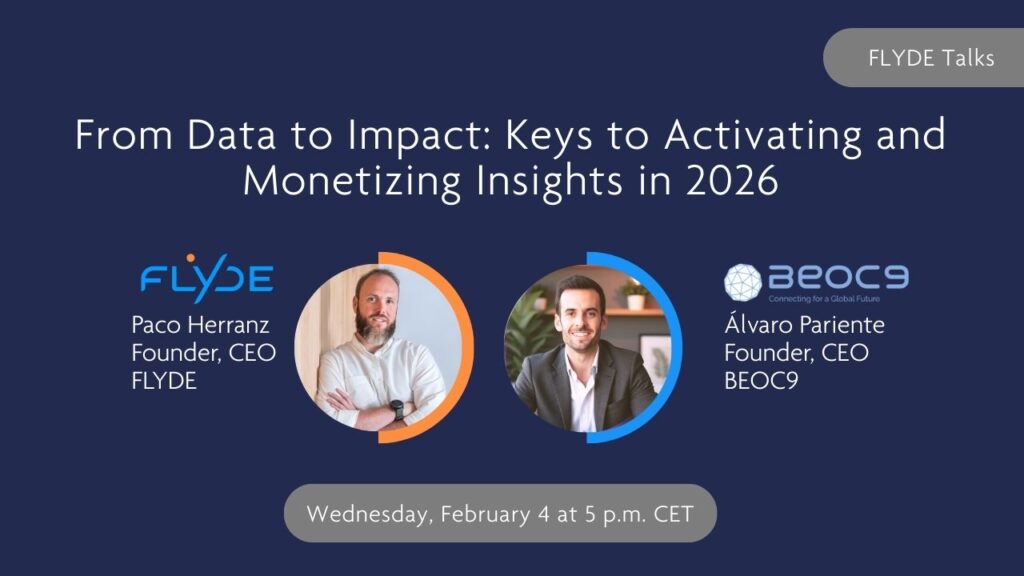
In this session, Francisco Herranz, founder and CEO of FLYDE, spoke with Álvaro Pariente, a leading data strategy expert who is the founder and CEO of BEOC9. Key topics included how organizations are restructuring internally around data, the role of the CDP in today’s stack, and how to apply generative AI on your data to produce insights, forecasts, and attribution without friction.
WOULD YOU LIKE TO TALK IN MORE DETAIL ABOUT HOW TO PREPARE YOUR COMPANY’S DATA FOR AI?
Contact us to schedule a conversation and discover how FLYDE can power your growth.