
Author: Katherine Gortz
The data ecosystem has undergone a decisive transformation in the last few years, reshaping the daily operations of virtually every business. The end of third-party cookies is no longer a looming threat; it is a concrete, operational reality. Privacy regulations are stricter. Generative AI is now embedded in the day-to-day workflows of most companies. And customers expect hyper-personalized experiences delivered with the highest standards of privacy and transparency.
In this context, Customer Data Platforms (CDPs) have become the essential infrastructure that supports modern marketing, customer experience and business intelligence.
Below are the trends that will truly define the CDP landscape in 2026.
1. THE CDP AS THE BACKBONE OF BUSINESS
With the deprecation of user-level cookie tracking and tighter consent regulations, the Customer Data Platform has become indispensable for understanding customer behavior. A CDP unifies first-party data from multiple sources (web, apps, physical stores, CRM, campaigns, customer service, etc.) and enriches it with demographic and contextual information. It resolves identities, builds 360º customer profiles, and enables accurate performance measurement.
But its role now extends far beyond marketing. CDPs increasingly support core business intelligence use cases, including:
- Demand forecasting
- Price and promotion optimization
- Multichannel sentiment analysis (including reviews)
- Customer lifetime value, churn, and acquisition modeling
- Omnichannel experience management across physical and digital environments
2. ARTIFICIAL INTELLIGENCE POWERED BY FIRST-PARTY DATA
AI has become the central engine for data activation and its rapid adoption is directly driving the strategic importance of CDPs. According to a Markets and Markets report, the global CDP market is expected to grow at a compound annual growth rate exceeding 30% in the period between 2025-2030, driven by rising demand for the technology.
AI is only as good as the data it consumes. Many companies that implemented AI without a strong first-party data foundation have had to rebuild their architecture around a CDP. Modern CDPs allow AI to generate predictive insights and personalized recommendations based on reliable, governed, unified data. As a result, business decisions become more accurate, timely, and contextual, boosting campaign performance, customer experience and ROI.
3. PRIVACY AND TRUST AS A COMPETITIVE ADVANTAGE
Stricter regulations and rising consumer concern over privacy have reset the industry’s priorities. Companies are responding in two ways:
- Building data architectures that are based on privacy-by-design
- Using a CDP to provide full transparency and traceability: where data comes from, how it is used, and by whom
Meeting regulatory standards, ensuring traceability and offering transparency do more than protect businesses legally; they build genuine competitive advantage. Customers reward trust, and organizations that treat privacy as a core operating principle cultivate stronger relationships with customers and long-term loyalty.
It’s no longer just about collecting information. It’s about earning trust.
4. USABILITY AND AUTONOMY FOR BUSINESS TEAMS
A CDP’s success no longer depends solely on technical expertise within IT. In 2026, the most effective platforms are combining power with accessibility: intuitive interfaces, automated workflows and visual tools that allow marketing, sales and business teams to work directly with data.
This autonomy removes bottlenecks, accelerates campaign activation, and turns complex datasets into strategic, actionable decisions, without relying on slow or highly specialized internal processes. The differentiator is no longer the technology itself, but the clarity and business relevance of the use case.
And adoption is becoming even easier. Modular CDPs are gaining traction: platforms in which companies activate only the components they need. This reduces the learning curve, eliminates unnecessary complexity and facilitates real adoption across teams.
5. REAL-TIME AS THE NEW OPERATING STANDARD
Updating profiles, segmenting audiences, and activating campaigns in seconds is now an expectation, not a differentiator. Real-time capability reshapes the customer relationship: businesses can personalize experiences instantly, respond to interest or churn signals in the moment, and optimize resources with greater precision.
Modern CDPs turn data into immediate action, closing the loop from insight to decision to execution in one integrated, efficient flow.
HOW FLYDE STANDS OUT
At FLYDE, we know companies want to generate real business impact without long technical processes. That’s why we focus on accelerating time-to-value, helping teams see results quickly. Our platform is intuitive, visual, and powerful, designed for use by marketing and business teams. And with personalized support from day one, every client unlocks the full potential of their data.
Contact us to schedule a conversation and discover how FLYDE can power your growth.

Marketing attribution measures the contribution of individual channels and touchpoints to conversions. It provides insight into how each interaction influences the customer journey and is critical for the optimization of budget allocation and campaign performance. Accurate attribution requires integrated datasets, including CRM records, website analytics, advertising platforms, and customer engagement data. Without clean and comprehensive data, even advanced models will produce misleading conclusions.
For technically minded marketers, understanding the mechanics and limitations of different attribution models is essential for selecting and implementing an attribution strategy. Let’s look at common models and their practical applications.
COMMON ATTRIBUTION MODELS
Last-click attribution
This model assigns all conversion credit to the final touchpoint. It is simple to implement and useful for evaluating channels that directly close conversions. However, it neglects the influence of earlier interactions, which may have been crucial in acquiring and nurturing the customer such as social or display campaigns. Last-click attribution is often biased toward retargeting campaigns.
Limitation: Overvalues closing channels such as brand search or affiliates.
Problematic in: Ecommerce with significant upper-funnel investment (social, influencers).
Example: Imagine you work for an ecommerce business, and you want to run a retargeting campaign for users with abandoned carts. You impact your target audience through an organic social post, an email marketing campaign, or a series of display ads. Last-click attribution will measure which of these touchpoints directly closed the sale.
First-click attribution
First-click attribution allocates all credit to the initial interaction. This highlights the role of awareness campaigns at the top of the funnel. While valuable for assessing early engagement, it can overvalue the first touchpoint and fail to recognize the cumulative effect of multiple interactions.
Limitation: Ignores remarketing or nurturing efforts.
Problematic in: B2B, long cycles, or high-involvement products.
Example: Suppose you run a SaaS company launching a new product. A potential customer first discovers your brand through a LinkedIn post, later sees a display ad, and finally clicks a retargeting email to sign up for a trial. First-click attribution will assign all credit to the LinkedIn post, which is useful if you are looking to discover which channel is driving the most awareness at the top of the funnel.
Linear attribution
Linear attribution distributes credit evenly across all touchpoints. Each interaction receives an equal fraction of the conversion value. This model is appropriate when all touchpoints are expected to contribute similarly, but it does not differentiate based on influence or timing. Linear models are limited in handling complex journeys where certain touchpoints have disproportionate impact.
Limitation: Assumes all touchpoints carry the same weight.
Problematic in: Industries where one touchpoint clearly dominates.
Example: Imagine a fashion retailer running a multi-channel campaign including Instagram ads, an email newsletter, and a Google search ad. A customer interacts with all three touchpoints before purchasing. Linear attribution will assign equal credit to the Instagram ad, the newsletter, and the search ad, which is helpful when you want to understand how all touchpoints collectively contributed to the conversion.
Time decay attribution
Time decay attribution applies exponential weighting to touchpoints based on their proximity to conversion. More recent interactions receive higher credit. The decay function can be calibrated to match conversion windows. This approach accounts for recency effects but may undervalue early engagement in long-cycle campaigns. Also, campaigns with irregular conversion timelines may require recalibration to avoid skewed insights.
Limitation: Undervalues early demand-generation efforts.
Problematic in: Impulse-purchase consumer goods.
Example: Consider a B2B company with a long sales cycle. A lead first downloads an e-book via organic search, later engages with a webinar, and finally clicks a demo request email a month later. Time decay attribution will give the most credit to the demo request email while still recognizing the earlier touchpoints. This approach is useful when you want to emphasize touchpoints closer to conversion.
Position-based attribution
Position-based models assign fixed weights to first and last interactions while distributing the remainder across middle touchpoints. Common configurations include a 40-20-40 split. This model seeks to balance recognition of awareness and conversion touchpoints but may underestimate the impact of middle-channel interactions. In multi-channel campaigns with longer sales cycles, this model may not reflect true influence without adjustments.
Limitation: Ignores key mid-funnel touchpoints.
Problematic in: Services with many intermediate steps in the funnel.
Example: A travel agency runs campaigns across Facebook ads, Google search, and through email marketing. A customer first clicks a Facebook ad, then sees a Google search ad, and finally completes a booking through an email. Position-based attribution might assign 40% credit to the Facebook ad, 20% to the Google ad, and 40% to the email, which balances recognition of the initial and final interactions while acknowledging the middle step.
Algorithmic attribution (Data-driven)
Algorithmic attribution leverages historical data and machine learning to assign conversion credit dynamically. Unlike linear models that assign equal credit, algorithmic models weight interactions based on observed influence on conversions. Models consider correlation and causation between touchpoints, the order of interactions, and channel-specific performance. Algorithmic attribution requires large, clean datasets and robust analytical infrastructure but provides the most granular and accurate insights.
Limitation: Requires large volumes of clean, traceable data.
Problematic in: SMBs, businesses with little data history, or with offline channels.
Example: An e-commerce platform uses multiple channels including Instagram, paid search, display, and email. A customer interacts with several of these before converting. Algorithmic attribution analyzes historical data to determine the actual influence of each touchpoint and might assign higher credit to Instagram and display, with less to email, based on observed contribution patterns. This is useful when you have enough data to understand nuanced interactions and want the most precise insight into channel performance.
HOW DO I CHOOSE THE ATTRIBUTION RIGHT MODEL FOR MY BUSINESS?
The choice of attribution model depends on business objectives, the complexity of the customer journey, channel mix, and available data infrastructure. Awareness-driven campaigns may benefit from first-click or position-based models, while performance-driven initiatives can leverage last-click or algorithmic models. Evaluating model outputs against historical performance helps identify biases and refine the attribution framework.
To make any of these models truly reliable, businesses must first centralize their data. Bringing CRM, ad platforms, web analytics, engagement data, etc. into a single platform produces the data set that serves as the foundation for advanced modeling. Incomplete or fragmented datasets, inconsistent UTM tagging, and discrepancies between CRM, analytics, and advertising platforms compromise attribution models. Failure to track activity across devices and browsers can also result in misallocated credit and inaccurate performance insights.
Without that unified dataset, even the most sophisticated attribution methods can only produce fragmented and biased insights. A Customer Data Platform (CDP) like FLYDE is designed to centralize data sources and enable implementation of advanced data analytics. Contact us at FLYDE to schedule a demo and we can show you how to prepare your data and implement advanced attribution modelling.

At the third FLYDE Talks event, FLYDE Founder and CEO, Paco Herranz, was joined by Víctor Moreno, Staff Data Scientist at TomTom, to explore the current state of generative artificial intelligence and its technological, professional and social implications. The discussion covered how we got to this point, what is truly changing, and the challenges companies must face in this new phase. A full recording of the event (in Spanish) is available.
A TECHNOLOGY THAT WASN’T BORN YESTERDAY
The conversation highlighted that while generative AI is currently trendy, AI itself is not a new concept. Its roots go back to early examples such as data analysis during World War II or the rule-based systems of the 1970s and 1980s.
The recent leap forward is not due to a new idea, but to technological advances that finally made long-standing concepts viable. GPUs enabled massive and efficient parallel computation. Natural Language Processing (NLP) allowed text to be converted into numbers more accurately. And the availability of large volumes of data made it possible to train much more powerful models.
THE DEMOCRATIZATION OF AI
The most recent change has been the democratization of access. Previously, working with AI required specific technical knowledge. Today, anyone can use it through simple interfaces like ChatGPT. This shift goes beyond workplace implications and into the social realm, changing how we perform personal tasks, such as asking an assistant for trivial data.
Víctor highlighted how this change is transforming even the way we ask questions. We rely on assistants to solve doubts, summarize information, or make initial decisions. This change is profound: it effects how we think, evaluate and structure our work.
By lowering the barrier to entry, adoption accelerates. Companies that do not adapt risk falling behind—not due to a lack of technology, but due to a lack of understanding of how to incorporate it effectively.
THE VALUE OF AI IN PRODUCTIVITY AND CREATIVITY
Víctor highlighted two key areas of value:
- Productivity: AI allows large amounts of information to be processed, content to be summarized, alternatives to be proposed, and tasks that previously took hours to be automated. For example, in programming, AI is improving productivity by an estimated 10–15%.
- Creativity: AI enhances creativity by removing the “fear of the blank page” and offering new ways to solve problems or start projects.
SPECIFIC APPLICATIONS IN MARKETING
Marketing is among the areas in which generative AI is growing exponentially. Personalization has been taken to a new level, handling thousands of micro-segments. Content can adapt dynamically. Campaigns can be optimized in real time. The list goes on.
At FLYDE, we’ve developed tools like FLYDE Brain, which proposes audiences from simple descriptions, analyzes behaviors, and suggests campaign optimizations, empowering teams to unlock more of AI’s potential for data-driven marketing.
Other AI applications in marketing include:
- Virtual replicas, which simulate how a customer might react to a message.
- Virtual replica farms, to conduct quick, low-cost surveys and market studies.
KEY RISKS AND CHALLENGES
Despite the progress, generative AI has significant limitations that must be carefully managed.
- Work slop: Poorly generated content can reduce productivity and damage credibility.
- User responsibility: Models are designed to respond, not to question. As Víctor explained, they can “lie” if the prompt pushes them in that direction. Ultimately, the user is responsible for what is generated. If “the car crashes,” the driver is responsible.
- Security risks: There is a risk of prompt injection, where the text consumed by the agent can be modified to influence its actions, potentially leading to unwanted access to databases if proper protection is not in place.
- Legality and data: In Europe, regulations such as GDPR require responsible and secure use. Platforms like FLYDE allow AI to work with real customer data in a controlled environment, avoiding unnecessary risks.
- Rising costs: Token prices will increase, so responsible and efficient use of AI is necessary.
FINAL ADVICE ON THE IMPORTANCE OF ADAPTING
Víctor emphasized the importance of adapting to the new paradigm, comparing it to the shift from the steam engine to the electric engine: industries took decades to realize they not only had to replace the engine, but completely change their work structures to leverage the new technology.
Looking forward, the challenge for companies will be learning to integrate this technology in a safe, responsible, and strategic way. At FLYDE, we will continue driving conversations that help understand this new scenario and leverage AI within a safe, results-oriented framework.
Contact us to learn more about how FLYDE can help your business leverage AI’s capabilities.
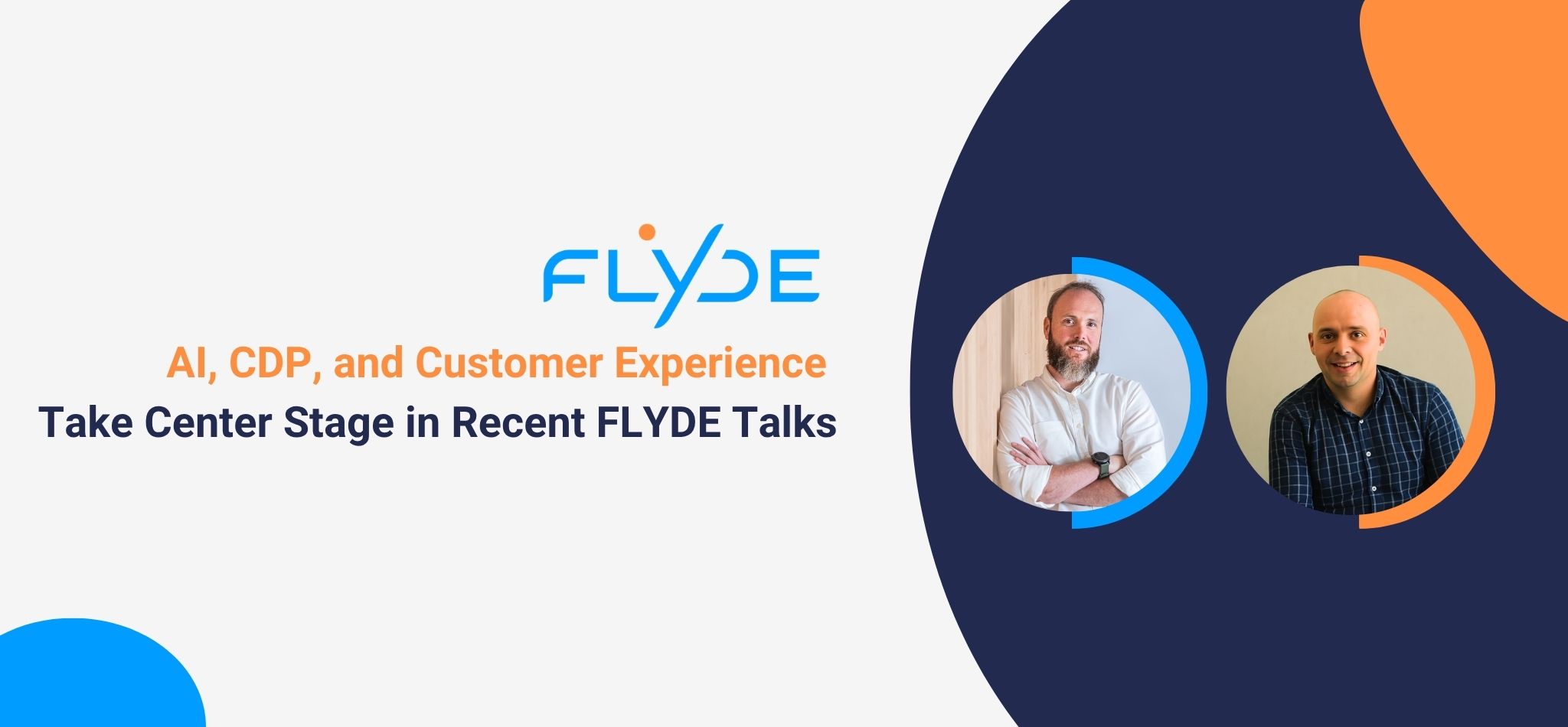
In this episode of FLYDE Talks, Luis Serrano, Head of Growth at Real Madrid, sits down with Paco Herranz, Founder and CEO of FLYDE, to explore how the concept of Growth Marketing has evolved in an environment shaped by artificial intelligence, extreme personalization, and data privacy—and how it can be applied to the unique context of football.
With this new episode of FLYDE Talks, we continue to bring together leading voices from across the marketing world to discuss, clearly and without jargon, the ideas that are transforming the industry today.
WHAT DO WE REALLY MEAN BY GROWTH?
Paco opens the conversation with a question every growth professional has asked themselves: What exactly do we mean by “growth”?
For Luis, the term has expanded significantly. What once referred to scaling digital channels now means understanding growth from a holistic perspective: digital and physical channels, data, user experience, and brand value.
“We’re no longer just talking about digital channels,” he says. “We’re talking about everything.”
Growth is no longer about funnel optimization alone; it’s about connecting every touchpoint between the user and the brand under one unified objective.
REAL MADRID’S ‘NORTH STAR’: THE SATISFIED MADRIDISTA
Paco and Luis agree that successful growth depends on having a clear metric that guides the overall strategy: the famous North Star Metric.
At Real Madrid, that North Star is the satisfied Madridista: a fan who trusts the club, shares their digital identity, and enjoys a full, consistent experience across online and offline channels. The satisfied Madridista is the “guiding star” behind every growth initiative at the club.
To measure that satisfaction, the team tracks KPIs that range from fan acquisition and retention, including engagement metrics, NPS (Net Promoter Score), and churn. The challenge lies in turning every interaction into a source of value, for both the fan and the brand.
‘ONE FAN, ONE EXPERIENCE’: UNIFYING DATA FOR ONE-ON-ONE PERSONALIZATION
From FLYDE’s perspective, growth can only scale if data is unified. It starts with data collection—first, second, and third party—and continues with data unification to create a single customer profile, the key to enable precise segmentation, activation, and measurement.
The unified customer profile is the foundation of any growth strategy. It allows teams to move from analysis to action: building micro-audiences, orchestrating omnichannel campaigns, and, most importantly, measuring attribution accurately. The real challenge isn’t gathering more data, but rather knowing where each impact truly comes from.
Real Madrid applies this philosophy with a simple vision: One fan, one experience.
From email to app, store to stadium, every interaction is tracked and optimized to deliver the best possible experience within the club’s ecosystem.
The ultimate goal is true micro-segmentation, evolving from “many-to-many” to “one-to-one,” offering each fan exactly what they need. As Luis puts it simply: “If I have a cat, why are you offering me dog food?”
Read more about the importance of data unification.
‘SEO IS NOT DEAD, AND GEO IS SEO.”
“SEO isn’t dead—and GEO is SEO.”
Through experiments with LLMs and metasearch engines, Luis found that generative AIs don’t search websites directly—they search search engines. In other words, for an AI to index your content, you still need to rank well on traditional search engines first.
So optimizing for visibility in AI results still means doing SEO: paying attention to microformats, structured data, and quality content. New tools, like Adobe’s LLM Optimizer, can even estimate how readable and indexable your content is for AI.
The takeaway is clear: the future of organic traffic will be hybrid and those who master SEO today will remain visible in the age of AI. At least based on what we know today.
MACHINE LEARNING AND GENERATIVE AI: THE NEW MARKETING DUO
Luis asks Paco how FLYDE integrates AI, and Paco explains that for him, AI isn’t a trend but a natural evolution of data-driven marketing.
FLYDE uses Machine Learning for key tasks:
- Measuring KPIs
- Detecting customer value patterns and projections
- Predicting churn
- Recommending products or audiences
On top of that, FLYDE has developed Brain, a generative AI layer across the platform. Brain acts as a data assistant, enabling any user, technical or not, to interact directly with their data ecosystem: building audiences, suggesting actions, analyzing campaigns, or even generating complex queries.
Its mission is to democratize access to data and remove the “blank page fear.”
As Luis jokes: “AI is like a shrimp cocktail—we have so many things to pick from that we don’t know where to start.”
THE CDP: THE NATURAL EVOLUTION OF THE CRM
Both speakers agree that a Customer Data Platform (CDP) like FLYDE is the strategic backbone that ties everything together.
At Real Madrid, the CDP is built around the Madridista Community, integrating data from e-commerce, the app, the Bernabéu tour, RMP Play, social media, and even in-stadium activity.
Thanks to this integration, the club can microsegment and activate data in real time. For instance, if a user is near the stadium, the system can trigger a personalized app notification with an offer or reminder.
The result is a coherent, contextual, and measurable experience—where data powers emotion.
Contact us to learn more about what the FLYDE CDP could do for your business.
PRIVACY AND REGULATION: GROWTH WITH RESPECT FOR THE USER
The new era of marketing comes with a non-negotiable condition: privacy.
Luis emphasizes that Real Madrid applies a strict transparency policy because trust is part of the fan experience itself.
Meanwhile, FLYDE advocates for ethical data usage. Its technology supports privacy-safe attribution using inferred data (such as average age, income level, or household type) to improve performance without compromising user trust.
The goal isn’t to know more, but to use what we already know better.
TOWARD A MORE HUMAN, MEASURABLE MARKETING
Growth marketing in 2025 operates at the crossroads of AI, CDPs, and customer experience.
But beneath it all lies a single principle: brands grow when they understand that data only matters when it creates satisfaction, trust, and real value.
Paco leaves us with an important conlcusion. Sustainable growth is born from the connection between data and people—and when done right, that connection is the future of marketing.

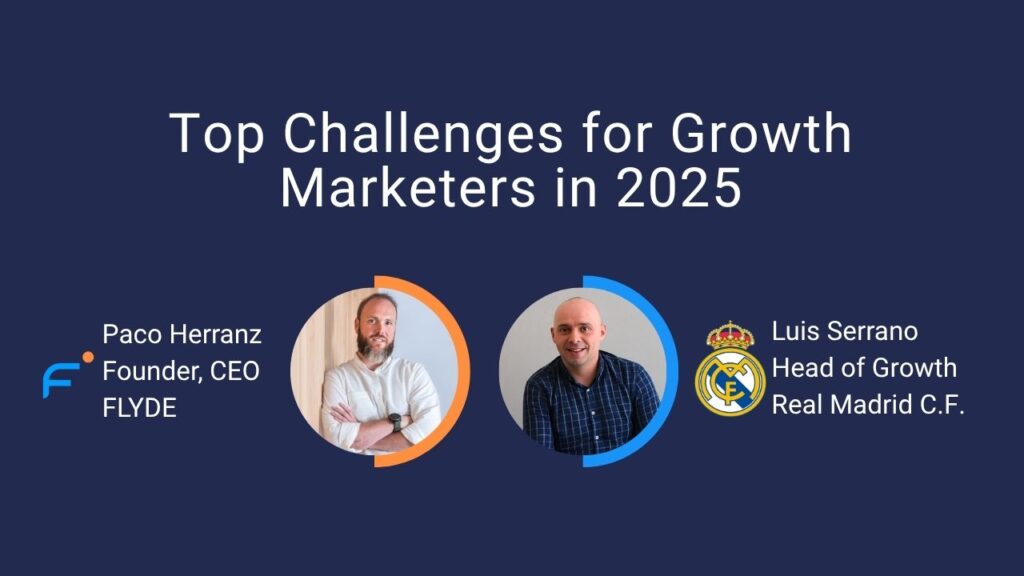
Growth marketers today need to be able to optimize campaigns across multiple channels, unify fragmented data, manage acquisition costs, and adapt to rapid industry changes. The challenge is not just executing campaigns but building a scalable, data-informed growth engine that drives sustainable results. The world of marketing has never been more complex… nor full of opportunity!
In this blog, we explore five critical challenges marketers face and how leveraging data activation and analytics can turn these obstacles into growth opportunities. By addressing these critical areas, marketing professionals can implement measured, scalable strategies that drive both immediate performance and long-term customer value.
For those who want to explore these challenges in depth, watch the full recording of FLYDE Talks 2 with Luis Serrano, Head of Growth at Real Madrid, where he shares practical insights on building scalable, data-driven growth strategies.
CHALLENGE 1: BALANCE SUSTAINABLE LONG-TERM GROWTH WITH SHORT-TERM GAINS
Marketing teams often face tension between demonstrating immediate results and nurturing long-term value. Sacrificing customer retention and lifetime value in favor of marketing qualified leads (MQL) or short-term revenue can create the illusion of growth while undermining sustainable performance. Advanced analytics can quantify the impact of retention versus acquisition, allowing leaders to defend their strategy with data rather than intuition. By modeling customer lifetime value alongside near-term KPIs, teams can make informed trade-offs that satisfy stakeholders without compromising long-term growth.
CHALLENGE 2: UNIFYING FRAGMENTED DATA
A single, reliable view of the customer is foundational for effective growth marketing, yet most organizations struggle with siloed systems, from CRM and ads platforms to product analytics and web tracking. Fragmentation reduces visibility and often biases measurement toward easily attributable channels.
Centralizing data enables marketers to track the full journey, uncover hidden opportunities, and deploy more precise targeting strategies. Tools that integrate data in real time and provide actionable segmentation allow for campaigns that are both sophisticated and measurable. If you are looking to build a sustainable and scalable growth strategy, unified data is an absolute must.
CHALLENGE 3: CHANNEL SATURATION AND RISING ACQUISITION COSTS
Undoubtedly many growth marketers are feeling the pressure of escalating customer acquisition costs (CAC) and formerly profitable channels becoming less cost ineffective. Growth marketers need frameworks for modeling CAC sensitivity and simulating different channel strategies to stay ahead. By forecasting cost changes and evaluating alternative acquisition levers, teams can anticipate disruptions and allocate budget dynamically, rather than reacting when profitability declines. This analytical rigor separates reactive teams from those driving consistent, scalable growth.
CHALLENGE 4: AI ADOPTION THAT ADDS TRUE VALUE
Artificial intelligence can accelerate campaign execution and uncover new insights, but its effectiveness depends on thoughtful application. Simply using AI to automate routine tasks does not differentiate a brand. Leading teams integrate AI into predictive modeling, hyper-personalization, and attribution analysis. To maximize impact, efficient algorithms must be used together with human creativity. The key is leveraging AI to provide insight and support smarter decision making rather than merely speed or volume.
CHALLENGE 5: CONTINUOUS INDUSTRY EVOLUTION
Growth marketing operates in a dynamic environment where technological, regulatory, and behavioral shifts can rapidly alter the rules of engagement. Strategies must be adaptive, incorporate scenario planning, and operate within agile measurement frameworks. Teams that continuously stress-test assumptions and adapt to emerging trends are better positioned to respond to disruptions while maintaining momentum.
LEARN MORE FROM AN INDUSTRY LEADER
The challenges of growth marketing are complex, but actionable strategies exist. In FLYDE Talks 2, Luis Serrano, Head of Growth at Real Madrid, to explores these topics in depth. Watch the full recording of the event.
Data integration is the essential first step for any business looking to implement artificial intelligence technology. Everyone is talking about AI right now. Marketing campaigns that adapt in real time. Customer service that anticipates needs before they are expressed. Predictive models that make complex business decisions feel effortless. The possibilities sound endless. But here is the part that does not always make the headlines: AI cannot deliver results without the right foundation. That foundation is reliable, complete and accurate data.
According to Gartner’s 2025 Hype Cycle for Artificial Intelligence Goes Beyond GenAI, 57% of organizations believe that their data is not AI-ready. When customer data is scattered across platforms, presented in disconnected reports, and divided into silos, no algorithm, no matter how advanced, can make sense of it. The Gartner report also indicated that less than 30% of AI leaders report that their CEOs are satisfied with the return on AI investments. When AI ambitions clash with siloed data ecosystems and infrastructure constraints, AI will fail to deliver results.
THE HIDDEN WORK: DATA INTEGRATION
Many organizations want to explore AI but quickly discover that their data is not ready. Information lives in CRMs, ecommerce platforms, analytics tools, and support systems. Without a single source of truth, it is impossible to build accurate models or generate reliable insights.
The less glamorous side of AI innovation is the behind-the-scenes work of data integration. Without centralizing data, records are incomplete or duplicated, transactions are disconnected from behaviors, and marketing touchpoints are measured in isolation. The result is noise, not intelligence.
Data integration means more than storing data in one central place. It means connecting, cleaning, and structuring information across all your businesses’ systems, applications, and data sources into a unified, usable format. This unified dataset transforms fragments into full customer profiles. It reveals the journey from the first interaction to the most recent purchase. Most importantly, it provides the context that makes AI accurate and actionable.
HOW FLYDE CAN HELP
The FLYDE Customer Data Platform (CDP) is designed to solve the integration challenge and prepare data for AI-driven use cases. FLYDE connects your data sources, from marketing tools and sales systems to customer service platforms. It collects, standardizes, and combines data into complete profiles that update in real-time.
Once centralized in FLYDE, your data is no longer trapped in spreadsheets or siloed reports. It becomes AI-ready data, structured for insights and accessible across your business units.
With FLYDE you can:
- Build a reliable single view of each customer.
- Feed clean, structured data into AI and machine learning models.
- Provide your marketing, sales, and operations teams with a consistent source of truth.
Once your data is unified, AI can finally do its job. Some of the most powerful opportunities include:
- Smarter personalization: recommending the right product at the right moment, based on actual behavior patterns.
- Leveraging predictive models: forecasting churn, customer lifetime value, or seasonal demand with confidence because the data feeding the model is complete.
- Optimized decision-making: allocating marketing spend where it produces measurable ROI, informed by a complete customer journey.
- Operational efficiency: reducing duplicated work and aligning teams around consistent data.
THE REAL AI MINDSET
AI is not the starting point. It is the outcome of disciplined data integration and unification. Businesses that centralize and structure their data today will be the ones leading with AI tomorrow. Without that preparation, even the most advanced algorithms will fail to deliver meaningful results.
So, if you are excited about AI, and who is not, start with the foundation. With FLYDE, you will not just join the conversation about AI. You will be ready to put it into action. Contact us to schedule a demo and we can show you the possibilities your data holds for AI implementation.

For many businesses, Black Friday–Cyber Monday (BFCM) is the most intense moment of the year for the business’s data. Traffic surges, transactions peak, and first-time buyers arrive in waves. For many brands, this weekend generates a huge portion of their annual revenue.
But the real objective shouldn’t be just to make the sale. The goal should be to convert those new buyers into long-term customers. Without a way to unify and activate data, brands often miss the opportunity to build loyalty after the sale, leaving a massive amount of valuable customer information and opportunity for growth on the table.
THE DATA CHAOS OF BFCM
During BFCM, data flows in from every direction: websites, mobile apps, paid ads, emails, and ecommerce platforms. The omnichannel nature of data sources presents a significant challenge. Customers appear under different IDs, creating fragmented and duplicated records that are almost impossible to activate for retargeting or loyalty campaigns later on. Instead of starting the new year with a stronger customer base, many brands are stuck cleaning up a data mess.
This is where a Customer Data Platform (CDP) becomes an essential tool. A CDP like FLYDE is built to handle this exact challenge by bringing all your customer data into one unified, intelligent platform.
HOW CAN FLYDE HELP?
Real-Time Identity Resolution
One of the most pressing technical challenges of BFCM data management is identity resolution. With traffic and transactions peaking, businesses need a way to link anonymous browsing sessions to known customer profiles.
A CDP like FLYDE combines first-party data such as emails, phone numbers, and loyalty IDs with anonymous digital signals. By resolving identities in real time, the platform eliminates duplicate records and builds a single, accurate profile of each customer. This ensures that even when activity spikes, businesses maintain a complete and coherent view of their customers’ journeys.
Smarter Segmentation
Not all BFCM buyers are equal. Some are loyal customers taking advantage of promotions. Others are deal hunters who may never return without the right follow-up. Treating both groups the same reduces efficiency and limits retention.
McKinsey research shows that companies excelling at customer personalization generate 40% more revenue from those activities than their peers. Advanced segmentation supported by a CDP enables businesses to separate high-value customers from bargain-driven shoppers. For example, FLYDE allows marketers to distinguish between customers who only purchase discounted items and those who also explore full-price collections. This insight shapes tailored post-purchase communication that increases the chance of long-term retention.
Omnichannel Activation
Clean, segmented data is only valuable when it can be activated across the right channels. Modern CDPs sync enriched profiles with platforms such as Meta Ads, Google Ads, email marketing tools, and SMS systems. This allows marketing teams to stop wasting spend on customers who already converted, deliver personalized journeys in the channels where customers are most active, and build targeted retargeting campaigns that deliver higher returns.
By closing the loop between data collection, unification, and activation, businesses ensure that the customer relationships formed during BFCM extend beyond a one-time transaction.
A PRACTICAL EXAMPLE
A consumer electronics retailer uses FLYDE ahead of BFCM to connect its Shopify store, email marketing platform, and Meta Ads. They create unified profiles for 120,000 customers and segment them by purchase margin, that is, those who buy discounted items versus those who pay full price.
After BFCM, the retailer can use FLYDE to trigger automated post-purchase journeys:
- High-value buyers receive loyalty rewards and exclusive early access to new products.
- One-time bargain hunters receive special re-engagement offers to encourage a second purchase.
Impact:
- Reduced duplicate ad spend.
- Higher retention rate for BFCM buyers compared to the previous year.
- Increased email engagement with tailored post-BFCM messaging.
READY TO GET STARTED?
BFCM is more than just a sales spike; it’s a data spike. Without a unified view of your customers, you’re missing a massive opportunity for long-term growth. With a CDP like FLYDE, brands can transform this sales surge into structured intelligence, ensuring they build a loyal customer base instead of just generating short-term revenue.
Ready to maximize your next BFCM? Contact us at FLYDE to book a demo and see how a our intuitive CDP can revolutionize your BFCM data strategy.

In your CRM, you have a customer named Juan Pérez.
In your email marketing platform, there’s a user with the email jperez@gmail.com.
In your loyalty program, another has the email, juanperez@hotmail.com.
And on your website, there’s a particular anonymous visitor who browses every week.
Your business sees them as four different people, but in reality, they’re the same customer.
When data isn’t unified into a single profile, it’s impossible to truly understand that customer’s journey. The same issue happens with hundreds or thousands of other clients: the fragmented, duplicated data and anonymous records actually correspond to individual people. Without unification, the trends that drive your business get lost in the data.
WHAT IS IDENTITY RESOLUTION?
Identity resolution is the process of unifying the fragmented pieces of information into a single customer profile. Two main approaches are used to achieve this:
- Deterministic Matching: Connects records using unique identifiers like an email address, phone number, or customer ID.
- Probabilistic Matching: Connects records based on behavioral patterns and similarities, such as the same device, IP address, or browsing history.
Combining both methods allows you to create a complete and reliable view: the 360-degree customer profile.
WHY IS IT KEY FOR MARKETING AND DATA?
Identity resolution isn’t just a technical exercise. It directly impacts your business results.
- Consistency: It prevents you from sending duplicate or contradictory messages.
- Personalization: It allows you to deliver relevant experiences across every channel.
- Accurate Measurement: One customer equals a single profile and a single set of KPIs.
- Compliance: It simplifies consent management and privacy requests by centralizing data at a single control point.
IMPLEMENTATION OF IDENTITY RESOLUTION WITH A CDP
A Customer Data Platform (CDP) simplifies and automates identity resolution. At FLYDE, we do it this way:
- Connecting to multiple data sources to centralize customer data and eliminate silos. This includes sources like CRM, e-commerce, campaigns, loyalty programs, web browsing, and more.
- Data normalization to clean, standardize, and remove inconsistencies.
- Applying smart matching rules that combine both deterministic and probabilistic approaches.
- Creating unique customer profiles that are enriched with every new interaction.
- Real-time updates so your teams always work with the most current information.
A PRACTICAL EXAMPLE
A fashion retailer analyzing its databases discovers it has the same customer registered four times: with different emails, as an anonymous website user, and as a member of their loyalty program. These records need to be consolidated into a single unified profile to personalize loyalty campaigns, reduce duplicate mailings, and improve the customer experience.
The identity resolution process is implemented in several phases:
- Integration: First, the CRM, e-commerce, loyalty, email marketing, and web browsing are connected in a single central repository.
- Cleaning and Normalization: Formats are unified (e.g., phone numbers with and without country codes), and incomplete records are removed.
- Smart Matching: Deterministic rules (same email, same phone number) and probabilistic rules (same device and purchasing behavior) are applied to consolidate duplicates.
- Unified Profile: Each customer now has a 360-degree profile, updated in real time with every new interaction.
You can expect to see results such as:
- A reduction in duplicate email mailings.
- An increase in conversion rates for retargeting campaigns.
- An improvement in the customer experience, as they no longer receive repeated or contradictory messages across different channels.
HOW FLYDE FITS IN: THE ROLE OF A CUSTOMER DATA PLATFORM (CDP)
With FLYDE, identity resolution is no longer a technical challenge. Our platform unifies each customer’s scattered data into a single, reliable profile that can be activated across all your channels. It enables you to run smarter campaigns, perform more precise segmentation, and create personalized experiences that generate real value for your customers.
Want to see how it works in practice? Contact us to request a demo, and we’ll show you how FLYDE can open up new possibilities for you.

At FLYDE, we talk with marketing teams every day about data, performance, and the customer journey. We often hear the same questions, so we’ve gathered the five most common ones, with clear answers and links to our blogs for more in-depth information.
1. WHAT IS MARKETING MIX MODELING (MMM) AND HOW CAN WE IMPLEMENT IT?
Marketing Mix Modeling (MMM) is a statistical technique that helps you understand which marketing channels are actually driving results. It analyzes variables like advertising, pricing, promotions, and seasonality to measure their impact on sales, conversions, and revenue. It uses historical, aggregated data, so it doesn’t rely on cookies or user-level tracking. That’s why we’re seeing more and more marketing teams turn to MMM.
More information on MMM and how to implement it:
👉 What is Marketing Mix Modeling?
2. CAN WE IDENTIFY ANONYMOUS WEBSITE USERS WITH NAVIGATION FINGERPRINTING AND IS THEIR CONSENT NEEDED?
Browser fingerprinting is a technique that can identify a device based on its technical characteristics (browser, screen resolution, language, etc.) without installing cookies. It allows you to track anonymous users across multiple sessions to better analyze user behavior in the early stages of the customer journey.
More information on fingerprinting and how to ensure user privacy:
👉 Navigation Fingerprinting: Tracking Anonymous Users Without Cookies
3. WHAT IS RFM ANALYSIS AND HOW DOES IT IMPROVE CUSTOMER SEGMENTATION?
RFM analysis is a statistical technique that involves analyzing customer data in terms of Recency (how recently they purchased), Frequency (how often they purchase), and Monetary value (how much they spend) to gain insights into the behavior of different customer groups. These groups can be used to optimize customer segmentation, improve retention, and maximize ROI and Customer Lifetime Value (CLV).
More information on RFM analysis and the role of a CDP:
4. WHAT IS A CUSTOMER DATA PLATFORM (CDP)?
A CDP unifies data from multiple sources, organizes it into unique profiles, and makes it actionable in real time. A CDP is a key component of modern data-driven marketing strategies.
We explain this in more detail and outline the benefits a CDP can bring to your business:
👉What is a Customer Data Platform (CDP)?
5. WHAT IS THE PROCESS FOR IMPLEMENTING A CDP?
FLYDE is an intuitive and simple platform. It can be implemented without the need for a specialized technical team. We invite you to request a demo and we can show you the process in detail.
Schedule a demo:
DO YOU HAVE ANOTHER QUESTION ABOUT DATA-DRIVEN MARKETING?
Contact us to let us know, and we’ll address it in a future post. Plus, if you want to see how a CDP can improve your data-driven marketing strategy, request a demo with FLYDE and we can discuss.
Marketing Mix Modeling is a statistical technique that helps marketers understand how different variables such as advertising, pricing, promotions, and seasonality impact business outcomes like sales, conversions, or revenue.
In simpler terms, MMM tells you how much each part of your marketing mix contributes to your results. It is based on historical, aggregated data, without requiring cookies or user-level tracking.
HOW DOES MMM WORK?
MMM analyzes data over time, typically at least two years, to isolate the incremental impact of each factor. It can measure both online and offline efforts such as:
- Paid search, social, and display advertising
- Traditional media like TV, radio, and print
- Promotions and pricing strategies
- Seasonality and external events like weather or competitor activity
By modeling these variables together, MMM provides attribution at the channel level and helps marketers understand the return on the investment (ROI) made in each channel.
WHY IS MMM MAKING A COMEBACK?
Marketing departments are increasingly accountable for justifying every cent they spend and demonstrating clear ROI on their activities. With budgets tightening and the deprecation of third-party cookies looming, many brands are looking back to a powerful, proven solution: Marketing Mix Modeling (MMM).
With the rise of user-level tracking via cookies and clickstream data, MMM took a back seat to multi-touch attribution (MTA). MTA is a marketing measurement model that assigns credit to multiple touchpoints along a customer’s journey to determine which channels and interactions influenced a conversion. Digital tracking, however, is facing significant obstacles due to privacy regulations. As a result MMM is becoming more relevant, because it uses aggregated data as opposed to user-level tracking, and covers both online and offline channels.
MMM VS. MULTI-TOUCH ATTRIBUTION
| Feature | MMM | MTA |
|---|---|---|
| Attribution type | Top-down (channel level) | Bottom-up (user level) |
| Data required | Aggregated, historical | User level, cookie-based |
| Works offline | Yes | No |
| Privacy compliant | Yes | Depends on data practices |
Rather than choosing one or the other, many brands are now combining MMM and MTA. MMM provides strategic, high-level planning while MTA supports tactical, in-the-moment optimization.
HOW FLYDE FITS IN: THE ROLE OF A CUSTOMER DATA PLATFORM (CDP)
At FLYDE, we help businesses unify and activate their customer data. This includes making the most of aggregate-level signals, which is where a Customer Data Platform (CDP) plays a crucial role in enhancing MMM.
A CDP is a centralized system that collects and unifies customer data from various sources (online, offline, behavioral, transactional, demographic) into a single, comprehensive customer profile. While MMM focuses on aggregate, historical data for channel-level insights, a CDP complements this by:
- Centralizing all marketing and sales data: A CDP acts as the single source of truth for all your customer-related data, making it easier to gather the diverse datasets needed for robust MMM. This includes data from CRM, ERP, web analytics, advertising platforms, and more.
- Cleaning and enriching datasets for modeling: CDPs are designed to ingest, cleanse, and standardize data from disparate sources. This ensures the data fed into MMM models is accurate, consistent, and complete, leading to more reliable insights. A CDP can also enrich data with additional attributes, improving the depth of your analysis.
- Once MMM provides insights on channel effectiveness and optimal budget allocation, a CDP can act as the bridge to activate these insights. It allows you to push segmentation and targeting recommendations derived from MMM directly to your ad platforms, email marketing tools, and CRM for more effective campaign execution.
- While MMM works with aggregated data, a CDP can provide a richer understanding by linking these aggregate insights with more granular behavioral data. Even without cookies, techniques like navigation fingerprinting (which anonymously tracks user journeys based on browser characteristics and other non-personally identifiable information) can be ingested by a CDP. This allows for a holistic view, where broad MMM findings can be refined and informed by observed customer behaviors, enabling more precise targeting and personalization within privacy boundaries.
This means smarter planning without compromising privacy and better orchestration of omnichannel efforts, from the first anonymous visit to long-term customer retention.
Marketing Mix Modeling aligns with the marketing industry’s most predominant trends: smarter measurement, responsible data use, and data-driven channel strategies.
HOW FLYDE CAN HELP
Want to learn more about how FLYDE supports MMM and helps unlock real omnichannel impact?
Contact us to schedule a meeting to discuss how a Customer Data Platform (CDP) like FLYDE can enable you to implement MMM in your business.